Engagement Ring Guide: Styles, Diamond Cuts, Settings, Metals and Important Selection Factors
An engagement ring is a piece of jewellery traditionally associated with a commitment to marriage or a long-term partnership. Its modern forms include many combinations of diamond shapes, ring styles, settings, and metals. Understanding these elements can make the subject easier to navigate, particularly for people comparing different designs, learning about diamond characteristics, or considering how a ring may fit into everyday use.
Context
What an Engagement Ring Represents
Engagement rings have a long history, with earlier forms appearing in several cultures and periods. The diamond engagement ring became particularly established in modern Western jewellery traditions during the twentieth century, while many regions have developed their own customs involving gold, gemstones, and symbolic jewellery.
Today, an engagement ring does not have one universal appearance. Some designs use a single central diamond, while others combine several stones. The ring may feature traditional proportions or incorporate contemporary shapes, mixed metals, colored gemstones, or unusual arrangements.
Main Parts of an Engagement Ring
An engagement ring can be understood through several basic components:
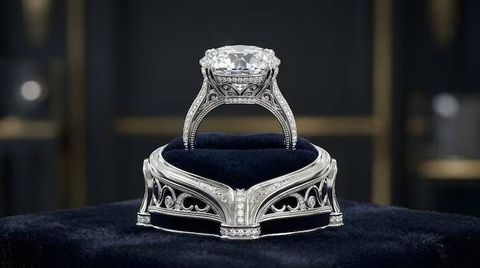
- Centre stone: The main gemstone, which may be a diamond or another gemstone.
- Diamond cut: The shape and faceting style of the stone, such as round, oval, emerald, pear, cushion, or princess.
- Setting: The structure that holds the gemstone in place.
- Band: The circular portion worn around the finger.
- Metal: The material used for the band and other structural elements.
- Accent stones: Smaller gemstones placed around the centre stone or along the band.
These components can be combined in many ways, so two rings with the same diamond shape may have very different appearances and practical characteristics.
Importance
Why Ring Design Matters
An engagement ring is normally worn on a finger and may remain there during many ordinary activities. Its design therefore involves more than visual appearance. The height of the setting, shape of the stone, metal type, and arrangement of small stones can affect how the ring feels and how it interacts with clothing or other jewellery.
The choice can also involve personal traditions, cultural preferences, finger proportions, and lifestyle considerations. Someone who frequently uses their hands may approach ring design differently from someone whose daily activities involve fewer physical tasks.
Understanding Diamond Characteristics
Diamond terminology can sometimes be confusing because several characteristics describe different aspects of a stone. The commonly discussed four Cs are cut, color, clarity, and carat weight.
Cut concerns how a diamond's facets interact with light. Color describes the degree of body color in a diamond, while clarity refers to internal and external characteristics. Carat weight describes the diamond's mass rather than its visual dimensions alone.
A larger carat weight does not automatically mean that two diamonds will look identical. Shape, proportions, setting, and viewing conditions can also influence their appearance.
Common Diamond Cuts and Shapes
Different diamond shapes create different visual effects and structural considerations.
| Diamond shape | General appearance | Common characteristic |
|---|---|---|
| Round brilliant | Circular | Numerous facets designed for strong light return |
| Oval | Elongated | Curved outline with an elongated appearance |
| Emerald | Rectangular or square | Step-cut facets with a broad, reflective look |
| Cushion | Rounded square or rectangle | Soft corners and broad proportions |
| Princess | Square | Angular outline and faceted appearance |
| Pear | Teardrop | Combination of rounded and pointed ends |
| Marquise | Elongated with pointed ends | Long, narrow outline |
| Asscher | Square step cut | Geometric appearance and concentric facets |
The term “cut” can refer both to a diamond's shape in everyday conversation and, more technically, to the quality of its proportions and facet arrangement. These meanings are related but are not identical.
Recent Updates
Personalised Ring Designs
Recent jewellery trends have shown continued interest in designs that allow individual expression. Industry and fashion coverage has highlighted colored gemstones, asymmetric settings, mixed metals, cluster arrangements, east-west orientations, and unusual diamond shapes as areas of growing design interest.
Step-cut diamonds, including emerald and Asscher styles, have also received renewed attention because of their geometric appearance. Unconventional shapes such as triangular and trapezoidal stones have appeared in contemporary jewellery design as designers experiment with more architectural forms.
Lab-Grown and Alternative Materials
Lab-grown diamonds have become a more visible part of the modern diamond market. They have the same basic chemical composition and crystal structure as mined diamonds, although their origin is different. Recycled metals and repurposed stones have also received attention in recent jewellery discussions.
These developments have expanded the range of materials and design approaches available for engagement rings. They also make it useful to understand terminology describing a gemstone's origin, grading, treatment, and material composition.
Hallmarking Developments in India
India's hallmarking framework has continued to expand. The Bureau of Indian Standards has issued several amendments to the mandatory hallmarking framework during 2024–2026, including additional district coverage. The current BIS information lists amendments through 2026.
For gold jewellery covered by the applicable requirements, BIS states that hallmark identification includes the BIS Standard Mark, purity or fineness marking, and a six-digit Hallmark Unique Identification number, commonly called HUID.
Laws or Policies
Indian Hallmarking Requirements
In India, hallmarking is governed through the BIS framework established under the BIS Act, 2016 and BIS Hallmarking Regulations, 2018. BIS describes hallmarking as the official determination and recording of precious-metal purity or fineness. Gold and silver are currently within the BIS hallmarking system.
Mandatory gold hallmarking applies according to the districts and categories covered by the applicable government orders. BIS has published amendments expanding the covered districts over time, with further amendments recorded in 2026.
There are also specified exemptions. BIS information identifies categories including certain low-weight articles, export articles, particular traditional jewellery categories, and some other specified circumstances. The exact applicability depends on the article and circumstances.
Consumer Verification
BIS provides a HUID verification facility through the BIS CARE application. Consumers can use the application's “Verify HUID” function to check information associated with a hallmarked gold jewellery article. BIS also states that consumers can have jewellery tested at a recognized Assaying and Hallmarking Centre.
India's consumer protection framework also includes the Consumer Protection (E-Commerce) Rules, 2020, along with related consumer protection rules. These rules are relevant to transactions conducted through online commerce platforms and form part of India's wider consumer protection framework.
Because regulations can change, readers should check current BIS and government information for requirements applicable to a particular jewellery article or transaction.
Tools and Resources
Diamond Grading Information
Gemological laboratories provide grading reports that describe characteristics such as diamond shape, measurements, color, clarity, cut-related information, and other identifying details. Examples of widely known gemological organizations include the Gemological Institute of America and the International Gemological Institute.
A grading report can help readers understand technical characteristics without relying only on visual descriptions. The report number and stone details should correspond with the diamond being examined.
Ring Size Tools
Ring-sizing guides and printable measurement templates can provide an initial estimate of finger size. Measurements can vary because fingers may change slightly with temperature, time of day, and other conditions, so a measurement should be treated as an estimate rather than an absolute value.
BIS Resources
For gold jewellery in India, the BIS website provides information about hallmarking, applicable standards, registered jewellers, consumer verification, and HUID identification. The BIS CARE application also provides a HUID verification feature.
Selection Factors to Understand
When comparing an engagement ring, several factors can be considered together:
- Ring style: Solitaire, halo, three-stone, cluster, or other arrangements create different visual structures.
- Diamond shape: Round, oval, emerald, cushion, pear, marquise, princess, and Asscher shapes have different proportions.
- Setting: Prong, bezel, halo, pavé, channel, and other settings hold stones in different ways.
- Metal: Gold and platinum have different characteristics, appearances, and maintenance considerations.
- Finger fit: Correct sizing affects comfort and reduces the likelihood of excessive movement.
- Daily use: The height and structure of the setting can matter when the ring is worn during routine activities.
- Documentation: Diamond grading reports and applicable metal hallmark information can provide useful identification details.
- Maintenance: Cleaning, inspection, and appropriate handling can help preserve the condition of jewellery over time.
FAQs
What are the main engagement ring styles?
Common engagement ring styles include solitaire, halo, three-stone, cluster, pavé, and vintage-inspired designs. The main difference is generally the arrangement of the centre stone and additional gemstones.
Which diamond cuts are commonly used in engagement rings?
Common diamond shapes include round, oval, emerald, cushion, princess, pear, and marquise. Each shape has a different outline and facet arrangement, so appearance can vary considerably between styles.
How do engagement ring settings affect a diamond?
The setting determines how the gemstone is held within the ring. Prong, bezel, halo, and other settings differ in their structure, visibility of the stone, and interaction with everyday activities.
What metals are used for engagement rings?
Gold and platinum are commonly used in jewellery. Gold can be produced in different purity levels and colors, including yellow, white, and rose gold. Platinum has a naturally pale appearance and is used in various jewellery designs.
What should be checked on a gold engagement ring in India?
For applicable hallmarked gold jewellery, readers can check the BIS Standard Mark, purity or fineness marking, and six-digit HUID. The HUID can be checked through the BIS CARE application.
Conclusion
An engagement ring combines several elements, including diamond shape, setting, metal, band design, and gemstone characteristics. Understanding these components makes jewellery terminology easier to interpret and helps explain why different rings have different appearances and practical characteristics. In India, applicable gold jewellery is also shaped by BIS hallmarking requirements and HUID identification. Current design trends include greater interest in personalization, unusual shapes, mixed metals, colored gemstones, and alternative diamond origins.