Automated Tool Changer Systems Guide: Designs, Tool Handling, Functions and Key Considerations
Automated Tool Changer Systems are mechanisms used in CNC machines and machining centres to move cutting tools between a tool magazine and the machine spindle without requiring manual tool replacement for every operation. These systems developed alongside computer numerical control, or CNC, machining as manufacturers needed machines to perform several cutting operations in sequence. Today, an automated tool changer can be part of a compact machining centre or a larger automated production system, helping coordinate tool storage, selection, positioning, and replacement.
What Is an Automated Tool Changer?
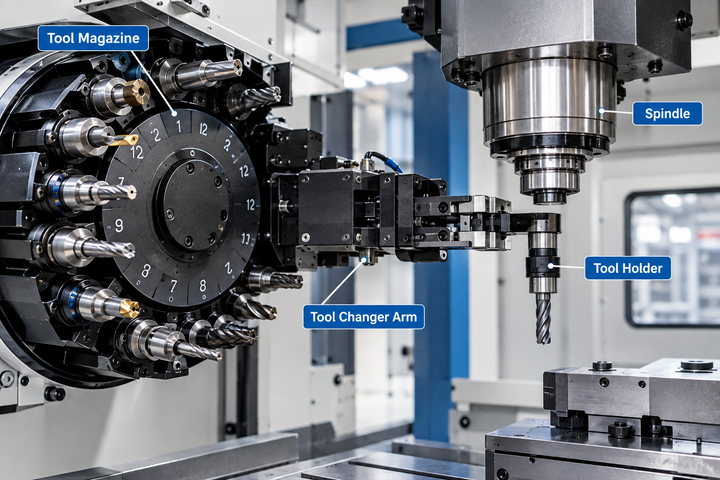
An automated tool changer, often called an ATC, is a mechanical system that selects and exchanges tools during a machining process. A typical arrangement includes a tool magazine, tool holders, a change mechanism, sensors, and machine-control software.
The CNC control identifies the tool required for the next machining operation. The machine then positions the spindle and changer mechanism so the current tool can be removed and another tool can be placed into the spindle. The exact sequence depends on the machine design and controller.
Why Tool Changers Were Developed
Early machining operations required operators to replace tools manually between different cutting stages. This approach could interrupt production and introduce opportunities for incorrect tool selection or positioning. As CNC machines became more capable, automated tool handling became useful for processes involving drilling, milling, boring, tapping, reaming, and other operations.
An automated system allows several tools to remain available within the same machine. The number of tools that can be stored depends on the machine and magazine configuration.
Main Components
A typical automated tool changer contains several coordinated parts:
- Tool magazine: Holds multiple cutting tools in designated positions.
- Tool holders: Connect cutting tools to the machine spindle.
- Change arm or mechanism: Transfers tools between the spindle and magazine.
- Sensors: Detect positions, tool presence, and movement conditions.
- CNC controller: Coordinates the tool-change sequence with machining instructions.
- Drive system: Provides the mechanical movement required for tool exchange.
- Safety system: Helps prevent access or movement conditions that could create hazards.
The design must allow these components to work together with the machine's spindle, enclosure, coolant system, and control software.
Importance
Reducing Manual Tool Handling
One important function of an automated tool changer is to reduce the need for repeated manual tool replacement. A machining program can call different tools as required, allowing a single workpiece to pass through multiple operations without stopping for every tool exchange.
This can be particularly useful when a component requires several machining stages. Tool selection, positioning, and confirmation can be coordinated through the CNC control.
Supporting Multi-Operation Machining
Modern machining centres may perform several operations on one workpiece. For example, one sequence could use a face mill, drill, end mill, and tapping tool. The automated tool changer provides access to these different tools from a shared magazine.
The system therefore affects how machining processes are planned. Tool capacity, holder dimensions, spindle compatibility, and change sequence all need to match the intended machining work.
Improving Process Consistency
Automated tool handling can make the physical tool-change sequence repeatable. However, consistent results also depend on correct tool measurement, holder condition, machine calibration, programming, and cutting parameters.
A tool changer does not independently determine whether a tool is suitable for a particular material or operation. Those decisions remain part of machining process planning.
Who Uses These Systems?
Automated tool changer systems are found in many manufacturing environments, including:
- Automotive component manufacturing
- Aerospace component machining
- General metalworking
- Electronics and equipment manufacturing
- Medical-device component production
- Die and mould machining
- Precision engineering
- Educational and research machining facilities
The requirements differ according to machine size, workpiece material, tool type, production volume, and the number of operations performed.
Recent Updates
Greater Integration With Digital Manufacturing
From 2024 through 2026, machine-tool development has increasingly connected physical machining equipment with digital software, tool data, simulation, and shop-floor monitoring. Siemens, for example, has described digital CNC management that connects tools, NC programs, and machine information within a connected manufacturing environment.
This trend affects automated tool changers because tool identification and tool data can become part of a broader digital workflow. Instead of treating the magazine as an isolated mechanical component, manufacturers can connect tool information with CNC programs and preparation processes.
Digital Twins and Simulation
Digital twin technology has also become more visible in CNC manufacturing. Simulation can represent machine movements and machining sequences before physical production, helping engineers examine potential collisions, tool paths, and process conditions.
Recent manufacturing developments have also combined CNC programming with 3D analysis and digital workflows. These developments indicate a broader movement toward digitally planned machining rather than relying entirely on manual setup procedures.
Tool Monitoring and Data Management
Another development is greater attention to tool condition and traceability. In 2024, Siemens announced expanded machine-tool digital offerings involving tool condition monitoring and digital-twin applications.
For automated tool changer systems, this can mean that information such as tool identity, position, measurement data, and condition becomes increasingly connected to machine-control and production-management systems.
Evolving Safety Standards
Safety requirements for machine tools continue to develop. ISO 16090-1:2022 covers safety requirements for machining centres, milling machines, and transfer machines, including machines equipped with tool magazines and tool changers. In 2026, ISO also began work on a new edition intended to replace the 2022 version.
This reflects continued attention to safeguarding moving machine components, access points, installation, operation, troubleshooting, and other stages of the machine life cycle.
Designs and Tool Handling
Carousel-Type Tool Changers
Carousel magazines arrange tool holders around a rotating circular structure. When a particular tool is requested, the magazine rotates until the required position reaches the change location.
This arrangement is commonly associated with compact machining centres because the magazine can store multiple tools within a relatively organized structure.
Chain-Type Tool Magazines
Chain magazines use linked tool pockets arranged along a continuous path. They can provide larger tool-storage capacity than compact carousel arrangements and are used where a machining process requires many different tools.
The physical layout can vary considerably between machines, so magazine capacity alone does not describe the complete capability of a tool-changing system.
Swing-Arm Tool Changers
A swing-arm mechanism moves between the spindle and magazine to exchange tools. The arm generally grips the incoming and outgoing tool holders and transfers them through a controlled movement.
The change sequence requires accurate coordination between spindle orientation, magazine position, arm movement, and machine control.
Direct Tool Changers
Some machine designs use mechanisms that move a tool directly between the magazine and spindle without a conventional swing arm. The arrangement can vary according to spindle design, magazine layout, machine size, and required change sequence.
Tool Handling Sequence
A simplified automated tool-change sequence generally follows these stages:
- The CNC program identifies the required tool.
- The machine moves to an appropriate tool-change position.
- The spindle releases the current tool.
- The magazine or changer mechanism positions the required tool.
- The changer transfers the tool into the spindle.
- Sensors or control logic confirm the required positions.
- Machining continues using the selected tool.
The exact sequence varies by machine manufacturer and controller.
Key Considerations
Tool Capacity and Size
Tool magazine capacity should correspond with the number of tools required by the machining process. Physical dimensions also matter because large-diameter or long tools may occupy more magazine space or restrict adjacent positions.
Tool Holder Compatibility
The tool holder must match the spindle interface and the machine's tool-changing mechanism. Common interfaces vary by machine type and application, so compatibility needs to be confirmed before operation.
Change Speed and Machine Layout
Tool-change time is one part of the overall machining cycle. The actual effect depends on how frequently tools are changed, the number of operations, and the movement required by the machine.
Sensors and Control Logic
Sensors help the CNC control determine whether components are in expected positions. Correct sensor operation is important because an incorrect position signal can interrupt the tool-change sequence.
Safety and Access
Moving tool magazines, changer arms, spindles, and doors can create mechanical hazards. Enclosures, interlocks, emergency controls, safe access arrangements, and appropriate operating procedures are therefore important parts of machine design.
Comparison of Common Designs
| Design | Typical Storage Approach | Main Characteristic | Common Consideration |
|---|---|---|---|
| Carousel | Circular magazine | Compact arrangement | Magazine capacity |
| Chain | Continuous chain | Larger tool storage | Physical footprint |
| Swing-arm | Arm transfers tools | Separate transfer mechanism | Movement coordination |
| Direct | Direct spindle transfer | Compact transfer path | Machine-specific compatibility |
Laws or Policies
India as the Reference Jurisdiction
Because no country was specified, this section uses India as the reference jurisdiction. Industrial machine safety is influenced by national labour requirements, applicable technical standards, and machine-specific compliance requirements.
India brought the Occupational Safety, Health and Working Conditions Code, 2020 into effect on 21 November 2025. Government information states that the Code consolidated 13 central labour laws and established a broader framework covering occupational safety, health, and working conditions.
Workplace Machine Safety
The OSH framework includes requirements relating to safe working conditions and machinery safeguards. For facilities using CNC equipment and automated tool changers, workplace safety procedures should therefore address moving machine parts, access controls, operating procedures, and other relevant hazards.
The Bureau of Indian Standards also maintains standards and certification information for machinery. Its materials identify machine-tool safety as an area covered by Indian standardization, while specific machinery categories can have additional conformity requirements.
Technical Standards
ISO 16090-1:2022 specifically addresses safety requirements for machining centres and milling machines and includes machines fitted with tool magazines and tool changers. Indian manufacturers and machine users may also need to consider applicable BIS requirements and state-level workplace rules depending on the equipment and facility.
Regulatory requirements can vary according to machine type, workplace conditions, establishment category, and applicable Indian rules. Technical compliance information should therefore be checked against the current requirements relevant to the particular installation.
Tools and Resources
CNC Manuals and Tool Tables
Machine manuals provide information about tool capacity, magazine layout, spindle interfaces, alarm codes, tool-change sequences, and operating procedures. Tool tables can also help organize tool numbers, holder information, offsets, and magazine positions.
CAM Software
Computer-aided manufacturing software can be used to create machining operations and tool paths. Modern CAM platforms increasingly include simulation and digital tool libraries, allowing programmers to review machining sequences before they reach the machine.
Digital Machine Monitoring
Digital shop-floor platforms can connect CNC machines, tool information, NC programs, and production data. These systems can help organize information about tool location, preparation, measurement, and machine assignments.
Industry Standards and Data Frameworks
The ISO standards database can be used to research machine-tool safety standards. BIS provides Indian Standards information and machinery-related conformity guidance. MTConnect is another technical resource for connecting manufacturing devices and exchanging machine data through an open standard.
FAQs
What is an automated tool changer system?
An automated tool changer system is a CNC machine mechanism that automatically moves tools between a tool magazine and the spindle. It coordinates tool selection and replacement through mechanical components, sensors, and CNC control logic.
How does an automated tool changer handle tools?
The tool magazine stores tool holders in assigned positions. When a CNC program requests a tool, the magazine positions it and the changer mechanism transfers it to the spindle while the previous tool is returned to its designated position.
What are the main automated tool changer designs?
Common designs include carousel magazines, chain magazines, swing-arm changers, and direct tool-changing mechanisms. The appropriate arrangement depends on machine architecture, tool capacity, tool dimensions, and the machining process.
How does a CNC tool changer improve machining workflows?
A CNC tool changer allows several tools to be used during one programmed sequence without repeated manual replacement. This can support multi-operation machining and reduce interruptions associated with manual tool handling.
What safety standards apply to automated tool changer systems?
Safety requirements depend on the country, machine type, and installation. ISO 16090-1:2022 provides safety requirements for relevant machining centres and includes equipment such as tool magazines and tool changers. In India, applicable BIS standards and the Occupational Safety, Health and Working Conditions framework should also be considered.
Conclusion
Automated Tool Changer Systems combine tool magazines, holders, mechanical transfer mechanisms, sensors, and CNC controls to manage tool changes during machining. Their designs range from compact carousel arrangements to larger chain-based systems and machine-specific direct mechanisms. Recent developments increasingly connect tool handling with digital tool data, simulation, monitoring, and machine-control systems. In India, machine-tool safety is also shaped by the Occupational Safety, Health and Working Conditions Code and applicable BIS and technical standards.