Engine Assembly Machines Learn: Assembly Technologies, Components, Functions and Industrial Applications
Engine assembly machines are industrial systems designed to help manufacturers assemble engines and their individual components in a controlled sequence. An engine contains many parts, including the cylinder block, crankshaft, pistons, connecting rods, cylinder head, valves, bearings, seals, and fasteners. Engine assembly machines help position, align, tighten, inspect, and test these components during production.
Engine assembly has developed from largely manual work into a combination of mechanical equipment, automation, sensors, computer controls, and inspection systems. Modern production lines can use dedicated machines for individual operations or integrated systems that connect several assembly stages. The exact arrangement depends on engine design, production volume, component characteristics, and required quality controls.
What Are Engine Assembly Machines?
Engine assembly machines are machines or automated stations used during the process of putting engine components together. Some systems perform a single operation, while others combine several functions.
Common examples include:
- Component positioning and fixture systems
- Automatic bolt tightening machines
- Press-fitting equipment
- Piston and connecting-rod assembly systems
- Bearing installation equipment
- Valve assembly machines
- Seal and gasket installation systems
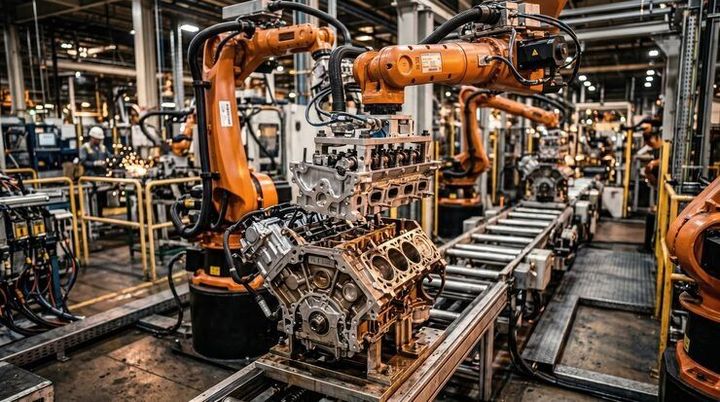
- Robotic handling systems
- Vision inspection equipment
- Engine testing and measurement stations
A typical engine assembly line moves components through a defined sequence. Fixtures hold parts in the correct position while sensors and controllers monitor important assembly conditions.
Main Assembly Technologies
Several technologies are used in engine assembly. Mechanical fixtures provide accurate positioning, while pneumatic or electric actuators move components. Servo systems can control movement, force, speed, and position with greater precision.
Robotic assembly is another technology used for repetitive handling and positioning tasks. Machine vision can inspect component orientation, presence, surface conditions, and assembly positions. Programmable logic controllers, commonly called PLCs, coordinate machine operations and receive information from sensors.
Data collection is also becoming an important part of assembly technology. Machines can record torque values, cycle information, inspection results, and equipment conditions, allowing production teams to trace individual assembly steps.
Importance
Engine assembly machines matter because engine production involves many components that must be assembled in a controlled order. Incorrect positioning, inadequate tightening, contamination, or missing components can affect the operation of an assembled engine.
Automation addresses several practical manufacturing challenges. It can provide repeatable movements, controlled tightening, measured pressing forces, and automatic inspection. These functions are particularly useful when the same assembly sequence must be repeated across a large production run.
Why Engine Assembly Requires Precision
Many engine components interact mechanically. For example, the crankshaft, bearings, connecting rods, and pistons operate together inside the engine. Their positions and clearances therefore need to remain within specified engineering limits.
Fastener tightening is another important operation. Automated torque tools can record tightening values and compare them with programmed parameters. If a measured result falls outside the configured range, the system can identify the assembly step for further inspection.
Who Uses Engine Assembly Technology?
Engine assembly technology is used across several industrial areas, including:
- Passenger vehicle manufacturing
- Commercial vehicle manufacturing
- Agricultural equipment production
- Construction equipment manufacturing
- Industrial engine production
- Generator manufacturing
- Marine engine production
- Engine component manufacturing
The same basic technologies can also be adapted to different engine sizes and configurations.
Major Components of an Engine Assembly Machine
| Component | Main function |
|---|---|
| Fixture | Holds components in a defined position |
| Servo actuator | Controls movement and position |
| Torque tool | Applies and records specified tightening |
| PLC | Coordinates machine operations |
| Sensors | Detect position, force, pressure, or presence |
| Vision camera | Performs visual inspection |
| Conveyor | Moves components between stations |
| Robot | Handles or positions components |
| HMI | Allows operators to monitor and control equipment |
| Data system | Records production and inspection information |
Together, these components create an assembly environment where mechanical operations and digital controls work together.
Recent Updates
Engine assembly technology has continued moving toward automation, digital monitoring, and flexible manufacturing during 2024–2026. Indian manufacturing policy has also placed greater attention on automotive technology, domestic component production, and advanced manufacturing.
One notable development is the wider use of industrial digital technologies. A 2024 Ministry of Heavy Industries review described an Industrial Internet of Things implementation at a Toyota engine manufacturing line through CMTI, with multiple machines connected for preventive maintenance. This illustrates how connected equipment can extend engine assembly beyond mechanical automation into data-based monitoring.
Artificial intelligence, machine learning, digital twins, robotics, and advanced manufacturing systems have also received greater attention. A NITI Aayog manufacturing roadmap published in 2025 identified these technologies as important enablers across several manufacturing sectors.
Shift Toward Data-Based Assembly
Modern engine assembly machines can capture information from individual production steps. A digital record may include tightening torque, angle, component identification, inspection status, cycle time, and machine condition.
This approach can help production teams identify recurring process variations. It also supports traceability because information can be associated with a particular engine or assembly stage.
Automotive Manufacturing Developments
India's automotive manufacturing sector has continued expanding its focus on advanced automotive technologies and domestic production. Government information published in 2026 reported substantial automobile production during 2025 across passenger vehicles, commercial vehicles, three-wheelers, and two-wheelers.
The Production Linked Incentive scheme for automobiles and auto components also remains part of India's manufacturing policy framework. As reported by the Ministry of Heavy Industries in 2026, cumulative investment under the scheme had reached ₹44,326 crore by March 2026, with incentives disbursed to eligible participants.
These developments are relevant to engine assembly because automotive manufacturing requires equipment capable of handling conventional engines, advanced components, and increasingly diverse powertrain technologies.
Greater Attention to Flexible Manufacturing
Production lines are also being designed with flexibility in mind. Instead of creating an entirely separate physical system for every engine variant, manufacturers can use programmable controls, adjustable fixtures, machine vision, and digital production instructions.
This can allow one assembly environment to handle variations in component dimensions or product configurations while maintaining defined process parameters.
Laws or Policies
Engine assembly machinery in India is affected by several areas of regulation, including machinery safety, occupational safety, automotive standards, electrical requirements, and environmental rules.
The regulatory environment has changed during the 2024–2026 period. The Ministry of Heavy Industries published the Machinery and Electrical Equipment Safety (Omnibus Technical Regulation) Order in 2024, followed by amendments and subsequent regulatory changes. The ministry's current official page records a withdrawal of the 2024 order in January 2026, so manufacturers should refer to the latest official notification rather than relying on earlier implementation schedules.
Worker Safety Requirements
The Occupational Safety, Health and Working Conditions Code, 2020 became effective in India from November 2025 as part of the implementation of four Labour Codes. The framework covers workplace safety, health, welfare, and working conditions.
For engine assembly facilities, safety considerations can include machine guarding, emergency controls, safe electrical arrangements, protective equipment, safe handling procedures, and risk controls around moving machinery.
Automotive Standards
Engine and vehicle manufacturers must also consider applicable automotive regulations and technical standards. Bharat Stage VI emission requirements are part of India's vehicle regulatory framework, with technical requirements covering different engine and vehicle categories.
Manufacturers and equipment planners therefore need to distinguish between regulations covering the assembled vehicle or engine and those covering the machinery used to manufacture it.
Tools and Resources
Several technical tools and information resources can help readers understand engine assembly machines and their operation.
Engineering and Production Tools
Common tools include CAD software for machine and fixture design, PLC programming environments for automated controls, torque monitoring systems, machine vision software, digital production records, and maintenance monitoring platforms.
Torque measurement equipment is particularly relevant to engine assembly because many fasteners require controlled tightening. Force sensors and displacement sensors can also monitor pressing and positioning operations.
Industry Resources
The Bureau of Indian Standards provides information about Indian Standards and conformity-related requirements. The Automotive Research Association of India provides technical information and testing-related resources for the automotive sector. The Central Manufacturing Technology Institute is another useful reference for manufacturing technology and industrial automation developments.
Government manufacturing portals can also provide information about current automotive policies, industrial programs, and technical regulations. Official sources should be checked when a regulation or policy is being used for an actual manufacturing decision.
Basic Assembly Data
A production team may monitor several measurements during an engine assembly process:
- Torque and tightening angle
- Pressing force
- Component position
- Temperature
- Pressure
- Cycle time
- Inspection status
- Machine alarms
- Component identification
Recording these measurements creates a clearer picture of how each assembly stage is performing.
FAQs
What are engine assembly machines?
Engine assembly machines are industrial machines used to position, install, tighten, inspect, and test engine components. They may operate as individual stations or as interconnected parts of an automated assembly line.
How do engine assembly machines work?
Engine assembly machines generally use fixtures, actuators, sensors, controllers, and tools to perform defined assembly operations. The machine follows programmed steps while sensors check conditions such as component position, force, or tightening results.
What components are used in engine assembly machines?
Common components include fixtures, servo actuators, torque tools, PLCs, sensors, conveyors, robots, cameras, human-machine interfaces, and data-recording systems. The exact configuration depends on the assembly operation.
What technologies are used in modern engine assembly?
Modern engine assembly can use robotics, machine vision, servo control, programmable logic controllers, Industrial Internet of Things systems, automated torque tools, and digital traceability. These technologies support controlled and repeatable production processes.
Are engine assembly machines regulated in India?
Yes. Engine manufacturing facilities and their machinery can be affected by workplace safety rules, machinery-related requirements, automotive regulations, electrical standards, and other applicable laws. India's regulatory framework has undergone changes during 2024–2026, so current government notifications and applicable Indian Standards should be checked for specific equipment.
Conclusion
Engine assembly machines combine mechanical equipment, automation, sensors, controls, and inspection technologies to assemble engine components in a controlled sequence. Their functions range from component positioning and fastening to inspection, testing, and production-data recording. Recent manufacturing developments in India have increased attention toward robotics, connected equipment, advanced automotive technologies, and digital manufacturing. Regulations covering workplace safety, machinery, and automotive production also remain important considerations when understanding engine assembly systems.