Industrial Air Conditioners Details: Systems, Components, Temperature Control, Uses and Maintenance
Industrial air conditioners are designed to control temperature, humidity, air movement, and indoor air quality in large or demanding environments. Unlike ordinary room air conditioners, industrial air conditioning systems can be integrated with production areas, warehouses, laboratories, data rooms, processing facilities, and other spaces where stable environmental conditions are important. Understanding industrial air conditioners involves looking at their system types, major components, temperature control methods, applications, maintenance practices, and current regulatory developments.
What Are Industrial Air Conditioners?
Industrial air conditioners are cooling systems designed for large buildings, industrial spaces, and specialized environments. They may use direct expansion equipment, chilled-water systems, packaged units, air-handling units, or variable refrigerant flow arrangements, depending on the building and cooling requirements.
The basic cooling process transfers heat from an indoor area to another location. A typical refrigeration cycle uses a compressor, condenser, expansion device, and evaporator. Air or water then distributes the cooling effect throughout the required area.
Why Industrial Cooling Developed
Industrial cooling became increasingly important as factories adopted machinery, electronics, automated production lines, and controlled manufacturing processes. Many machines release heat during operation, while some materials require stable environmental conditions.
Modern industrial air conditioning can therefore serve two purposes: maintaining a suitable environment for people and controlling conditions that affect equipment, materials, and production processes.
Common Industrial Air Conditioner Systems
Different facilities use different arrangements. Common types include:
- Packaged air conditioning systems: Cooling and air-handling components are combined into a packaged arrangement.
- Chilled-water systems: A chiller produces cooled water that circulates to air-handling equipment.
- Direct expansion systems: Refrigerant directly removes heat from the air passing through an evaporator coil.
- VRF systems: Variable refrigerant flow systems adjust refrigerant movement among multiple indoor units.
- Precision cooling systems: These are designed for environments requiring closely controlled temperature and humidity.
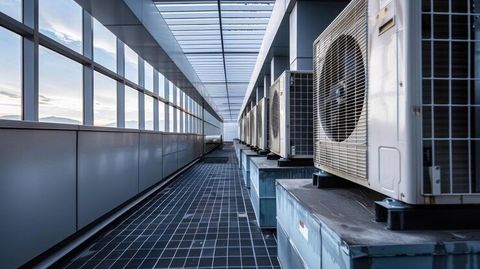
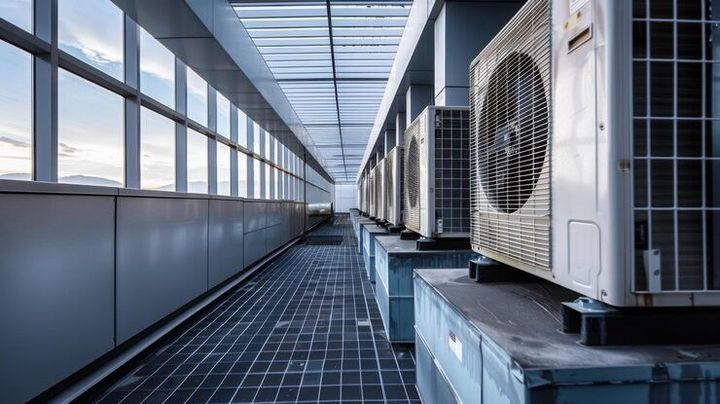
- Rooftop systems: Equipment is installed on a roof and connected to indoor ductwork.
The appropriate arrangement depends on building size, heat load, ventilation requirements, operating hours, humidity, and environmental conditions.
Importance
Temperature Control in Industrial Areas
Temperature control can affect workers, machinery, materials, and electronic equipment. Excessive heat may create uncomfortable working conditions and can also affect equipment operation in areas containing sensitive components.
Some processes require a relatively stable temperature rather than simply a cooler room. Industrial air conditioners can therefore use thermostats, sensors, controllers, variable-speed equipment, dampers, and automated controls to regulate indoor conditions.
Humidity and Air Quality
Cooling systems can also remove moisture from indoor air. This is important in facilities where excessive humidity may contribute to condensation, material deterioration, corrosion, or unsuitable working conditions.
Ventilation is another important consideration. Fresh outdoor air may be introduced through mechanical ventilation, while filters can remove certain airborne particles. The ventilation arrangement must be matched to the building and the activities taking place inside it.
Areas That Use Industrial Cooling
Industrial air conditioners are used across many sectors, including:
- Manufacturing plants
- Warehouses and distribution facilities
- Pharmaceutical and laboratory environments
- Food-processing areas
- Data and server rooms
- Electronics manufacturing
- Textile production
- Printing facilities
- Automotive production
- Research facilities
- Commercial buildings with large conditioned areas
The required cooling approach can vary significantly between these environments. A warehouse may mainly require broad temperature control, while an electronics or data environment may require continuous and closely monitored cooling.
Major Components
| Component | Main function |
|---|---|
| Compressor | Circulates and compresses refrigerant |
| Condenser | Releases heat from the refrigerant |
| Expansion device | Reduces refrigerant pressure |
| Evaporator | Absorbs heat from indoor air or water |
| Air-handling unit | Moves and conditions air |
| Filters | Capture selected airborne particles |
| Thermostat or sensor | Measures environmental conditions |
| Control system | Regulates equipment operation |
| Fans and blowers | Move air through the system |
| Ducts or pipes | Distribute conditioned air or chilled water |
Each component contributes to the overall cooling cycle. A problem in one part can affect the performance of the wider system.
Recent Updates
Energy Efficiency and Building Controls
From 2024 through 2026, energy efficiency and automated HVAC controls have remained important areas of development in India. The Energy Conservation and Sustainable Building Code 2024 includes requirements covering HVAC equipment, controls, ventilation, chillers, ductwork, and related building systems. It also includes efficiency requirements for several categories of air-conditioning equipment.
Modern systems increasingly use variable-speed drives, digital sensors, automated temperature controls, demand-controlled ventilation, and monitoring systems. These technologies allow cooling capacity to respond more closely to changing building conditions.
Refrigerant Transition
Refrigerant selection is also changing. India has ratified the Kigali Amendment to the Montreal Protocol, with a phased reduction of HFC production and consumption beginning from 2032. Government initiatives during 2024–2026 have included work on low-global-warming-potential refrigeration and air-conditioning technologies, including industrial and large commercial equipment.
This transition has increased attention toward refrigerant selection, equipment efficiency, leak prevention, recovery practices, and safe handling.
Smart Monitoring
Another continuing trend is the integration of sensors and digital monitoring. Industrial cooling systems can monitor temperature, humidity, pressure, airflow, equipment status, and energy use. Data from these systems can help operators identify unusual operating conditions and schedule inspections based on equipment performance.
Laws or Policies
Energy Conservation Requirements in India
In India, building energy efficiency is influenced by the Bureau of Energy Efficiency and building codes adopted or applied by relevant authorities. The Energy Conservation and Sustainable Building Code 2024 contains requirements for HVAC systems and controls, including ventilation, chillers, packaged equipment, VRF systems, and computer-room air-conditioning systems.
The exact applicability depends on the building category, project conditions, and the authority responsible for implementation. Project documentation should therefore be checked against the requirements applicable to the particular facility.
Refrigerant and Environmental Rules
India's refrigerant transition is also connected with the Montreal Protocol and its Kigali Amendment. Government reporting states that India is following a four-step HFC phase-down beginning in 2032, with further reductions scheduled for subsequent years.
The government has also continued work related to the phase-down of HCFCs. Its 2024–25 annual report states that HCFC-22 is scheduled for complete phase-out in manufacturing sectors from 1 January 2025 under the applicable Ozone Depleting Substances rules, as amended.
Safety Standards
Indian Standard IS 16678 addresses safety and environmental requirements for refrigerating systems and heat pumps. The standard covers areas such as system classification, design, installation sites, operation, maintenance, repair, and refrigerant recovery.
Industrial facilities may also need to consider electrical safety, fire protection, building requirements, ventilation rules, and occupational safety requirements depending on the facility and location.
Tools and Resources
Cooling Load Calculators
Cooling load calculators estimate the amount of cooling required for a particular space. Inputs can include room dimensions, outdoor temperature, insulation, windows, occupancy, lighting, machinery, and ventilation.
For larger industrial facilities, detailed engineering calculations are normally used because machinery and process heat can significantly affect the required capacity.
Temperature and Humidity Sensors
Digital temperature and humidity sensors can continuously monitor indoor conditions. Data loggers can record measurements over time, making it easier to identify temperature variations and recurring environmental changes.
Energy Monitoring Tools
Energy meters and building-management platforms can track electrical consumption and equipment operation. Such information can be reviewed alongside cooling output and operating schedules to understand how the HVAC system behaves.
Government Resources
The Bureau of Energy Efficiency provides information related to building energy codes, HVAC efficiency, energy conservation programs, and equipment standards. Its Energy Conservation and Sustainable Building Code resources include guidance on HVAC systems, equipment efficiency, controls, ventilation, and building performance.
For refrigerant-related information, the Ministry of Environment, Forest and Climate Change provides updates concerning India's Montreal Protocol obligations, refrigerant transition, and related programs.
Maintenance Records
A maintenance log can record filter cleaning, coil inspection, refrigerant-related observations, temperature readings, electrical measurements, alarms, and component inspections. Keeping these records helps establish a history of equipment operation.
FAQs
What are industrial air conditioners used for?
Industrial air conditioners are used to control temperature, humidity, ventilation, and air movement in factories, warehouses, laboratories, data rooms, processing facilities, and other large or specialized environments.
How do industrial air conditioners control temperature?
Industrial air conditioners use sensors and control systems to measure indoor conditions and adjust cooling equipment. Depending on the system, compressors, fans, valves, dampers, or chilled-water flow can be adjusted to maintain the required temperature.
What are the main components of an industrial air conditioner?
The main components generally include a compressor, condenser, expansion device, evaporator, fans or blowers, filters, sensors, and control equipment. Chilled-water systems also use chillers, pumps, pipes, and air-handling units.
How often should industrial air conditioners be maintained?
Maintenance frequency depends on equipment type, operating hours, environmental conditions, and manufacturer instructions. Common activities include filter inspection, coil cleaning, airflow checks, electrical inspection, sensor verification, and examination of refrigerant-related components.
Why are refrigerants important in industrial air conditioning?
Refrigerants transfer heat through the cooling cycle. Their environmental characteristics and safe handling are increasingly important because India is implementing a phased reduction of HFCs under the Kigali Amendment.
Conclusion
Industrial air conditioners provide controlled cooling for manufacturing, storage, electronics, laboratories, data environments, and other specialized facilities. Their operation depends on components such as compressors, condensers, evaporators, expansion devices, fans, sensors, and control systems. Recent developments have placed greater attention on energy efficiency, automated controls, refrigerant transition, and environmental considerations. In India, building-energy requirements and refrigerant policies are important factors when designing, operating, and maintaining industrial cooling systems.