Molding Machine Explained: Types, Components, Working Principles, Applications and Benefits
A molding machine is industrial equipment used to shape materials into specific forms through heat, pressure, compression, injection, or other controlled processes. Molding machines are widely associated with plastics manufacturing, although related systems are also used with rubber, metals, composites, ceramics, and other materials.
The basic idea behind molding is to place a material into or around a shaped mold and then use a controlled process to produce a particular geometry. Once the material reaches the required condition, the finished component can be removed from the mold. The exact process depends on the material, product design, machine configuration, and production requirements.
Modern molding machines developed from mechanical forming systems into equipment that can incorporate hydraulic, pneumatic, electrical, electronic, and computerized controls. These developments have made it possible to control variables such as temperature, pressure, speed, timing, and material flow with greater precision.
Molding machines are found in industries ranging from packaging and automotive manufacturing to electronics, medical equipment, construction materials, household products, and industrial components.
Basic Purpose of a Molding Machine
The primary purpose of a molding machine is to produce repeatable shapes from a selected material. A mold provides the desired cavity or surface profile, while the machine supplies the force and process conditions required to form the material.
The process can involve several stages, including material preparation, mold closing, material forming, cooling or curing, mold opening, and part removal. Some machines perform these stages automatically, while others require greater operator involvement.
Importance
Molding machines are important because many manufactured products require precise and repeatable shapes. Producing the same component manually can be difficult when large quantities or consistent dimensions are required.
The equipment also supports different production scales. Small machines may be used for limited production or laboratory work, while large automated systems can process substantial quantities of material in industrial environments.
Manufacturing Applications
Molding technology is used for products and components such as:
- Plastic containers and packaging components.
- Automotive interior and exterior parts.
- Electrical housings and connectors.
- Household products and fittings.
- Construction components.
- Medical and laboratory products.
- Rubber seals and technical components.
- Industrial covers, panels, and enclosures.
The selected molding process depends on the physical characteristics of the material and the shape of the final product.
Production Considerations
Several factors influence the selection of a molding machine. Material type is one of the first considerations because different polymers, rubbers, metals, and composites require different temperatures, pressures, and processing conditions.
Product geometry is also important. Thin walls, deep cavities, detailed surfaces, internal channels, and large dimensions may require different machine configurations or mold designs.
Other considerations include:
- Required production volume.
- Part dimensions and weight.
- Mold size and configuration.
- Required forming pressure.
- Temperature requirements.
- Automation level.
- Cooling or curing requirements.
- Available factory space.
- Electrical and utility requirements.
Recent Updates
Greater Use of Electric Systems
Molding equipment has increasingly incorporated electric drive systems and electronically controlled components. Electric systems can provide precise movement control and allow manufacturers to monitor process parameters through digital interfaces.
Hybrid machines can combine electrical movement systems with hydraulic components where particular force requirements exist. The configuration varies by machine manufacturer and application.
Automation and Process Monitoring
Automation has become an important part of modern molding operations. Sensors can monitor temperature, pressure, position, cycle time, and other process variables.
Computerized control systems can use this information to maintain process settings and identify variations. Some production environments also connect machines to factory monitoring systems so operators can review equipment information centrally.
Energy Management
Energy consumption has received greater attention in manufacturing. Machine designs increasingly consider efficient motors, variable-speed systems, improved heating controls, and optimized hydraulic circuits.
The actual energy requirements depend on the machine type, material, cycle, production conditions, and operating practices. Therefore, equipment specifications should be evaluated for the particular application rather than assuming that one machine configuration will have the same energy profile as another.
Data and Predictive Maintenance
Industrial equipment is increasingly capable of collecting operating information. Temperature readings, pressure measurements, cycle counts, alarms, and maintenance records can be stored electronically.
This information can help maintenance teams identify unusual operating patterns and plan inspections. Predictive maintenance systems may use historical and real-time information to identify conditions that could require attention.
Types of Molding Machines
Molding machines can be classified according to the material, forming method, machine design, and application.
Injection Molding Machines
Injection molding machines melt or soften a suitable material and force it into a mold cavity under controlled pressure. After the material cools or solidifies, the mold opens and the component is removed.
These machines are widely used for thermoplastic components and can produce products with complex geometries. Machine specifications commonly include injection capacity, clamping force, mold dimensions, and injection speed.
Compression Molding Machines
Compression molding places a measured amount of material into an open mold. The mold then closes and applies pressure while heat may be used to shape and cure the material.
This method is frequently associated with thermosetting materials, rubber compounds, and certain composite materials. It can be suitable for components that require relatively strong or durable structures.
Blow Molding Machines
Blow molding is primarily used to create hollow products. A heated plastic tube or preform is positioned inside a mold, after which air pressure expands the material against the mold walls.
Common applications include bottles, containers, tanks, and other hollow plastic products. Different blow molding methods are selected according to product dimensions and material requirements.
Rotational Molding Machines
Rotational molding uses a hollow mold that rotates around one or more axes while the material is heated. The material gradually coats the internal surface of the mold.
This process can produce large hollow products such as tanks, containers, playground components, and industrial housings. It is particularly useful for certain products with relatively uniform wall structures.
Transfer Molding Machines
Transfer molding moves a prepared material charge from a chamber into a closed mold cavity. Pressure is applied to distribute the material throughout the cavity.
The process is used for selected rubber, thermosetting plastic, and composite applications. It can accommodate shapes that may be difficult to produce through simpler compression processes.
Components of a Molding Machine
The exact components vary according to machine type, but several systems are commonly found.
Clamping System
The clamping system holds the mold securely during the forming process. In an injection molding machine, it also provides the force needed to resist the pressure generated when material enters the mold.
Clamping systems may use hydraulic, mechanical, electrical, or hybrid mechanisms.
Injection or Material Delivery System
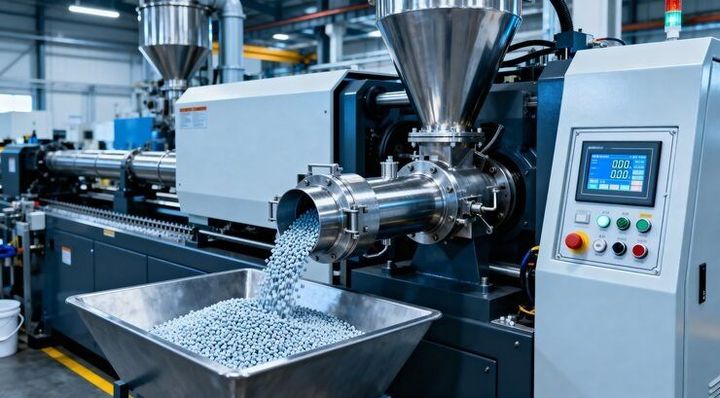
In injection molding, the injection unit prepares and moves the material into the mold. Major components can include a hopper, barrel, screw, heater bands, and nozzle.
The screw can perform several functions, including conveying, melting, mixing, and injecting the material.
Mold
The mold contains the cavity that determines the shape of the finished component. Molds can contain multiple cavities when several components need to be produced during one cycle.
Mold design can also include cooling channels, runners, gates, ejector mechanisms, and other features.
Heating and Cooling Systems
Temperature control is important because many molding processes depend on carefully controlled material temperatures. Heating systems bring the material or mold to the required operating range.
Cooling systems remove heat after forming. In many processes, cooling time can influence cycle duration and the final dimensions of the component.
Control System
The control system allows operators to configure and monitor process parameters. Depending on the equipment, the interface may display temperature, pressure, speed, cycle time, alarms, and production information.
Working Principles
Although molding processes differ, a general sequence can be described.
- Material preparation: Raw material is prepared according to the selected process.
- Mold preparation: The mold is positioned and configured for production.
- Material forming: Heat, pressure, mechanical force, air pressure, or another process is applied.
- Filling or shaping: The material occupies the required mold area.
- Cooling or curing: The formed material reaches the required solid or cured condition.
- Mold opening: The mold separates after the process reaches the appropriate stage.
- Part removal: The finished component is removed manually or through an automated mechanism.
- Inspection: Dimensions, appearance, and other requirements can be checked.
Cycle conditions vary according to material, machine design, mold geometry, and product specifications.
Applications and Benefits
Molding technology is used across many manufacturing sectors because it can accommodate a wide range of product shapes and materials.
Industrial Applications
Automotive manufacturers use molding processes for selected interior panels, covers, housings, clips, and structural components. Electronics manufacturing can use molding for protective housings, connectors, and insulation-related components.
Packaging applications include bottles, containers, caps, closures, and other formed plastic products. Construction manufacturing can use molding for fittings, panels, drainage components, and other products.
Key Benefits
Molding machines can provide several manufacturing advantages:
- Repeatable production of defined shapes.
- Ability to produce complex geometries.
- Compatibility with various materials and formulations.
- Integration with automated production lines.
- Consistent process monitoring.
- Suitability for different production volumes.
- Reduced manual handling in automated systems.
The actual results depend on machine design, mold quality, material properties, operating parameters, and maintenance practices.
Tools and Resources
Several resources can help users understand molding equipment and production processes.
Machine Specification Sheets
Technical specification sheets commonly provide information about clamping force, injection capacity, mold dimensions, machine dimensions, power requirements, and control features. These documents can help readers compare equipment characteristics.
Mold Design Software
Computer-aided design and engineering software can be used to create mold and component designs. Simulation tools may also evaluate material flow, cooling behavior, filling patterns, and potential production issues before physical tooling is produced.
Process Calculators
Manufacturing calculators can help estimate parameters such as material volume, component weight, cycle time, clamping requirements, and cooling conditions. These calculations are generally starting points and may require validation under actual production conditions.
Maintenance Records
Maintenance templates can record inspections, lubrication activities, component replacements, alarms, and operating hours. Keeping organized records can help production teams understand equipment history and identify recurring issues.
FAQs
What is a molding machine?
A molding machine is industrial equipment that shapes a material using a mold and controlled combinations of heat, pressure, force, air, or other process conditions.
What are the main types of molding machines?
Common types include injection molding machines, compression molding machines, blow molding machines, rotational molding machines, and transfer molding machines. Each type uses a different method and is suited to particular materials and product designs.
How does an injection molding machine work?
An injection molding machine prepares and heats suitable material before forcing it into a mold cavity. The material then cools or solidifies, after which the mold opens and the finished part is removed.
What are the main components of a molding machine?
Common components include a clamping system, material delivery or injection system, mold, heating and cooling systems, control system, and various safety and monitoring components.
Where are molding machines used?
Molding machines are used in automotive, packaging, electronics, construction, household products, medical equipment, industrial manufacturing, and other sectors that require formed components.
Conclusion
Molding machines use controlled forming processes to produce components with defined shapes and dimensions. Different machine types, including injection, compression, blow, rotational, and transfer molding systems, are designed for different materials and applications. Machine components such as molds, clamping systems, heating systems, material delivery systems, and controls work together to complete the production cycle. Automation, digital monitoring, energy management, and data-based maintenance continue to influence modern molding equipment.