UV Curing Systems Guide: Technology, Curing Methods, Equipment Types and Industrial Applications
UV curing systems are technologies that use ultraviolet light to harden or cure specially formulated materials such as coatings, inks, adhesives, and resins. Instead of relying mainly on heat or long drying periods, these systems use controlled UV radiation to trigger a chemical reaction that changes a liquid or semi-liquid material into a solid film.
The basic idea of UV curing has developed alongside advances in industrial coatings, printing, electronics, and manufacturing. As production processes became more automated, manufacturers needed curing methods that could work quickly within controlled production environments while fitting into conveyor lines and other processing equipment.
How UV Curing Works
A typical UV curing process uses a light source, a material containing light-sensitive components called photoinitiators, and a controlled exposure period. When the material receives an appropriate wavelength of UV radiation, the photoinitiator starts a chemical reaction that causes the resin or coating to form a solid structure.
The process generally involves these stages:
- Material application: A coating, ink, adhesive, or resin is placed on a suitable surface.
- UV exposure: The material passes beneath or in front of a UV light source.
- Chemical reaction: UV energy activates the photoinitiator within the formulation.
- Curing: The material changes into a solid or more stable film.
- Inspection: The cured surface can be checked for appearance, hardness, adhesion, or other required properties.
UV curing systems can use different wavelengths and energy levels depending on the formulation and application. The relationship between wavelength, irradiance, exposure time, material thickness, and formulation is important because changing one factor can affect the curing result.
Common UV Light Sources
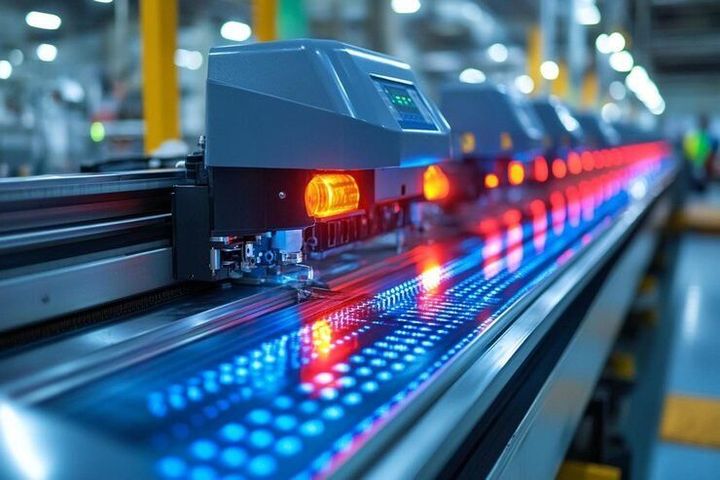
Traditional systems commonly use mercury-based UV lamps, while modern installations increasingly use UV LED technology. UV LEDs generate ultraviolet radiation within selected wavelength ranges and can be arranged in compact modules.
UV LED systems have become an important area of development because they can provide controllable light output and can be integrated into automated equipment. Their suitability depends on the photoinitiator and material formulation being used.
Importance
UV curing systems are relevant across several manufacturing activities because curing is often an important stage between material application and the next production step. A controlled curing process can help establish the required surface characteristics before products move through additional operations.
Applications can be found in printing, electronics, optical components, wood finishing, packaging, automotive components, medical-device manufacturing, flooring materials, and industrial coatings. The exact process varies according to the substrate and formulation.
Problems Addressed by UV Curing
Conventional drying can depend on evaporation, heating, or extended exposure to surrounding conditions. UV curing provides another approach in which a photochemical reaction creates the solid film.
This can be particularly useful where manufacturers need controlled processing conditions or where heat-sensitive substrates are involved. However, UV curing is not appropriate for every material, and formulations must be designed to respond to the available UV spectrum.
Factors Affecting Curing
Several factors influence how effectively a UV curing process works:
- UV wavelength
- Irradiance at the material surface
- Exposure time
- Material thickness
- Pigment concentration
- Photoinitiator chemistry
- Distance between lamp and substrate
- Surface condition
- Conveyor speed
A mismatch between the UV source and the material can result in incomplete curing. For this reason, UV curing equipment and the formulation generally need to be considered as parts of the same process.
Recent Updates
From 2024 through 2026, UV curing technology has continued moving toward LED-based systems, digital monitoring, improved optical control, and greater integration with automated production equipment. UV LED modules are increasingly being designed for specific wavelength ranges and industrial processes rather than as general-purpose light sources.
Another trend is greater attention to process monitoring. Sensors and control systems can monitor variables such as lamp output, temperature, conveyor movement, and operating conditions. This can help production teams identify changes in the curing process before they create larger process inconsistencies.
UV LED Development
UV LED curing continues to develop as manufacturers work on higher-output emitters, improved cooling arrangements, longer operating periods, and more precise optical designs. Different wavelengths can be selected according to the photoinitiator system used in a particular coating, ink, adhesive, or resin.
The shift toward LED technology does not mean conventional lamps have disappeared. Mercury-based and other lamp technologies remain present in industrial installations where their spectral characteristics match existing materials and processes.
Automation and Process Control
Modern UV curing equipment can be connected with programmable production systems. Automated controls may adjust conveyor movement, lamp intensity, cooling, or operating sequences.
This trend is also connected with manufacturing data systems. Production facilities can record operating parameters and compare them with process results, helping operators understand how changes in equipment conditions affect curing.
Laws or Policies
In India, UV curing equipment can be affected by several categories of requirements depending on its design, application, workplace, electrical characteristics, and industrial process. There is not one single regulation that covers every UV curing system.
Electrical and machinery safety requirements can involve applicable Bureau of Indian Standards provisions and other conformity requirements. BIS maintains product-specific information for electrical equipment and machinery, including safety certification frameworks for specified machine categories.
UV radiation is also a workplace safety consideration. Equipment should be designed and operated so that unnecessary exposure to UV radiation is prevented. Enclosures, interlocks, shielding, warning information, and appropriate operating procedures can form part of a safe installation.
Environmental requirements can become relevant when UV curing is used with coatings, inks, or other industrial formulations. In India, pollution control is administered through the Water Act, Air Act, and Environment Protection Act, with the Central Pollution Control Board and State Pollution Control Boards involved in implementation and monitoring. Industrial units may require applicable consent to establish or operate depending on their activity and pollution category.
Environmental characteristics can also depend on the formulation being cured. For example, coating-related environmental requirements can address volatile organic compounds and hazardous substances. The applicable requirements depend on the particular material, industry, and production process.
Because regulations can differ between applications and locations, technical and regulatory requirements should be checked against the specific installation rather than assuming that one rule applies to every UV curing system.
Tools and Resources
Several resources can help readers understand UV curing systems and evaluate process parameters.
UV Measurement Equipment
Radiometers can measure UV intensity at the working surface. These instruments can help determine whether a curing system is delivering consistent radiation during operation.
UV Dose Calculators
UV dose calculations can relate irradiance and exposure time. A simplified relationship is:
UV Dose = Irradiance × Exposure Time
Actual curing behavior can be more complicated because wavelength distribution, material chemistry, substrate characteristics, and other factors also influence the result.
Technical Standards
Standards organizations such as the Bureau of Indian Standards and the International Electrotechnical Commission publish documents covering electrical safety, machinery, radiation-related hazards, and other technical subjects. The applicable standard depends on the equipment and its intended use.
BIS information also shows that safety requirements can include protection from optical radiation and other equipment hazards in relevant electrical standards.
Manufacturer Documentation
Technical manuals, lamp specifications, LED module information, photoinitiator data, maintenance instructions, and equipment operating limits are useful resources when studying a UV curing process. These documents can help operators understand wavelength requirements, exposure conditions, cooling arrangements, and safety features.
Basic Comparison of UV Curing Technologies
| Feature | Mercury UV Lamp | UV LED System |
|---|---|---|
| Light source | UV lamp | Semiconductor LEDs |
| Spectrum | Relatively broad | Selected wavelength ranges |
| Heat generation | Can be significant | Generally concentrated around the module and electronics |
| Switching | Requires lamp operating sequence | Can be switched electronically |
| Form factor | Larger lamp assemblies are common | Compact modular designs are common |
| Process control | Lamp output and cooling require monitoring | Electronic control can provide precise adjustment |
| Material compatibility | Depends on formulation | Strongly dependent on LED-compatible photoinitiators |
The table provides a general comparison. Actual equipment characteristics vary between designs and applications.
FAQs
What is a UV curing system?
A UV curing system uses ultraviolet radiation to initiate a chemical reaction that hardens materials such as coatings, inks, adhesives, and resins. The system normally combines a UV light source with controlled exposure and suitable material chemistry.
How do UV curing systems work?
UV curing systems work by exposing a light-sensitive formulation to an appropriate UV wavelength. Photoinitiators absorb the radiation and initiate a reaction that changes the formulation into a more solid and stable material.
What are the main UV curing equipment types?
Common UV curing equipment types include mercury lamp systems, UV LED systems, conveyor curing units, spot-curing systems, flood-curing systems, and integrated curing modules. The appropriate configuration depends on the material, substrate, production method, and required exposure pattern.
Are UV LED curing systems different from conventional UV lamps?
Yes. UV LED systems use semiconductor light sources that generally produce selected wavelength bands, while conventional UV lamps can provide broader spectral output. This difference means that the material formulation and photoinitiator need to match the selected light source.
Where are UV curing systems used?
UV curing systems are used in areas such as printing, electronics, coatings, adhesives, packaging, wood finishing, optical components, automotive components, and other manufacturing processes. The exact application depends on the material and curing requirements.
Conclusion
UV curing systems use controlled ultraviolet radiation to transform suitable coatings, inks, adhesives, and resins into solid or more stable materials. The technology includes conventional lamp systems as well as increasingly developed UV LED equipment, with process control and automation becoming important areas of development. Successful curing depends on factors such as wavelength, irradiance, exposure time, material chemistry, and equipment configuration. In India, applicable electrical, workplace, machinery, and environmental requirements depend on the specific equipment and industrial application.