AI Data Center Cooling Systems Explained: Technologies, Components, Benefits and Applications
AI data center cooling systems are technologies designed to control the temperature of computing equipment that processes, stores, and transfers digital information. They are becoming increasingly important as artificial intelligence (AI) models require powerful processors to handle large datasets, train neural networks, and generate responses. These workloads can produce substantial amounts of heat, making effective cooling essential for reliable data center operation.
Context
AI data center cooling systems are technologies designed to control the temperature of computing equipment that processes, stores, and transfers digital information. They are becoming increasingly important as artificial intelligence (AI) models require powerful processors to handle large datasets, train neural networks, and generate responses. These workloads can produce substantial amounts of heat, making effective cooling essential for reliable data center operation.
Traditional data centers mainly supported websites, business applications, databases, and cloud computing. AI workloads have introduced additional thermal challenges because graphics processing units (GPUs), specialized AI accelerators, and high-density server racks can concentrate considerable electrical power in relatively small spaces. AI data center cooling systems manage this heat through air circulation, liquid-based technologies, heat exchangers, and automated monitoring.
Understanding AI Data Center Cooling
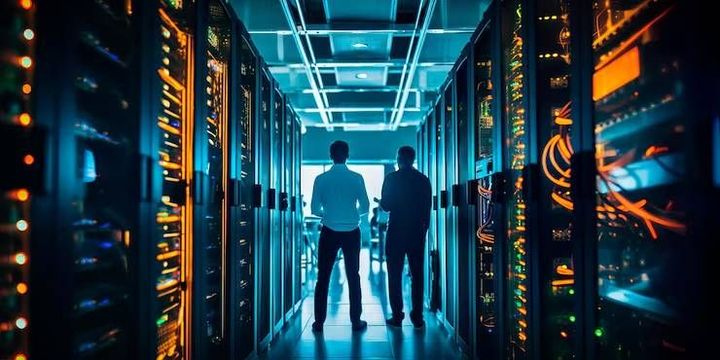
A data center contains servers, networking equipment, storage systems, power distribution equipment, and supporting infrastructure. Nearly all the electrical energy consumed by computing equipment eventually becomes heat that must be removed or transferred elsewhere.
Cooling systems maintain operating conditions within the equipment manufacturer's specified limits. Their design depends on processor density, rack configuration, room layout, outdoor climate, available water, and the facility's operating requirements. A system suitable for conventional server racks may not adequately support a densely packed AI computing environment.
Why AI Equipment Requires Specialized Cooling
AI training and inference can involve many processors operating simultaneously for extended periods. When several high-power processors are installed in one rack, the resulting heat can exceed the practical capacity of conventional room-level air cooling.
Excessive temperatures may cause processors to reduce their operating speed, increase equipment failure risks, or trigger protective shutdowns. Cooling infrastructure therefore forms an important part of AI computing capacity, alongside electrical power, networking, and data storage.
Importance
AI data center cooling matters to businesses, researchers, cloud computing providers, and people who use digital applications. AI tools depend on computing facilities to process requests, analyze information, support scientific research, and run business applications. Reliable temperature management helps these facilities operate consistently.
Cooling also affects energy consumption, water use, building design, and the environmental footprint of digital infrastructure. The overall impact depends on the cooling method, local climate, electricity supply, workload, and how heat is removed from the building.
Main Components of a Cooling System
An AI data center cooling system contains several connected components. Their arrangement varies according to the facility's design and cooling technology.
Cooling distribution units (CDUs): Transfer heat between equipment cooling loops and facility cooling circuits in liquid-cooled installations.
Pumps: Move cooling liquid through pipes, heat exchangers, and equipment cooling channels.
Heat exchangers: Transfer thermal energy between fluids or between a fluid and another cooling medium without necessarily mixing them.
Fans and air handlers: Circulate air through server racks and cooling equipment.
Chillers: Remove heat from a circulating fluid when required by the facility's cooling design.
Sensors and control systems: Monitor temperatures, pressure, flow rates, humidity, and equipment status.
Pipes and manifolds: Distribute coolant to the appropriate equipment and return heated fluid for cooling.
The components work together to move heat away from processors and transfer it to the surrounding environment. Some installations use several cooling methods simultaneously to manage different parts of the facility.
Comparing AI Data Center Cooling Technologies
Different cooling technologies suit different computing densities and facility conditions.
| Cooling technology | How it works | Common application |
|---|---|---|
| Air cooling | Fans move air across heat-producing components | Conventional server rooms and some AI racks |
| Direct-to-chip liquid cooling | Coolant flows through cold plates attached to selected processors | High-density AI servers |
| Immersion cooling | Equipment is placed in a specially designed dielectric liquid | Selected high-density computing environments |
| Rear-door heat exchangers | A heat exchanger removes heat from air leaving a server rack | Facilities with concentrated rack heat |
| Chilled-water cooling | Chilled water absorbs heat through cooling coils or connected heat exchangers | Larger data center facilities |
No single method suits every data center. Some facilities combine air cooling with direct-to-chip liquid cooling, while others use specialized systems designed around particular server platforms.
Recent Updates
Between 2024 and 2026, AI infrastructure development has increased attention on high-density rack cooling, liquid-based heat transfer, and energy-efficient thermal management. As AI processors become more powerful and rack power requirements rise, data center designers are evaluating cooling systems alongside electrical distribution and facility capacity rather than treating cooling as a separate building function.
Growth of Direct-to-Chip Liquid Cooling
Direct-to-chip liquid cooling has gained attention because liquids can transfer heat efficiently when properly circulated through suitable cold plates. In these systems, coolant absorbs heat near processors and carries it to a heat exchanger or cooling distribution unit.
This arrangement can reduce the amount of heat that must be removed by room air conditioning. However, fans may still be needed for memory, power components, networking equipment, and other parts that are not directly liquid-cooled. Installation requirements include leak detection, compatible materials, pressure control, maintenance procedures, and appropriate coolant management.
More Efficient Heat Rejection
Data center operators are also examining ways to reject heat with less mechanical refrigeration. Depending on outdoor conditions, some systems can use air-side or water-side economization, which takes advantage of suitable environmental temperatures to reduce chiller operation.
Warm-water cooling designs and heat recovery are also receiving attention. Captured heat may sometimes support nearby buildings or other suitable uses, depending on temperature, distance, infrastructure, and local demand. These approaches do not eliminate every energy requirement, and their practicality varies by location.
Automated Thermal Monitoring
Monitoring software can combine sensor readings with information about computing workloads, pump performance, fan speeds, and equipment temperatures. Automated controls can adjust cooling operation as conditions change, while predictive maintenance tools may identify unusual temperature patterns or equipment behavior.
Artificial intelligence can assist with analysis and control, but automated decisions still require appropriate safeguards. Poor sensor data, incorrect configuration, or unexpected equipment changes can affect system performance. Human oversight and established operating procedures remain important.
Laws or Policies
AI data center cooling systems are affected by building regulations, electrical and mechanical safety requirements, environmental rules, water management policies, and energy-efficiency expectations. Requirements differ by country, state, and municipality, so a facility's design must reflect the regulations applicable to its location.
Regulations and Standards in India
In India, data center projects may need to comply with applicable building rules, fire safety requirements, electrical safety provisions, environmental permissions, and local water-related requirements. The exact obligations depend on the facility, its location, its power infrastructure, and the activities taking place on the site.
The Bureau of Energy Efficiency (BEE) provides energy-efficiency frameworks and guidance relevant to buildings and energy management. The National Building Code of India, issued by the Bureau of Indian Standards, provides technical provisions relevant to building planning, fire and life safety, and building services. Applicability depends on the relevant legal and local adoption arrangements.
Environmental requirements may also apply to water withdrawal, wastewater discharge, refrigerants, backup power systems, and equipment disposal. Large projects should assess applicable central, state, and local requirements rather than assuming that one approval covers every aspect of the facility.
Energy, Water, and Operational Safety
Cooling designs must consider energy use as well as thermal performance. Data center operators may track Power Usage Effectiveness (PUE), which compares total facility energy consumption with the energy consumed by IT equipment. PUE is useful for facility-level comparison, but it does not independently measure water use, carbon emissions, or computing efficiency.
Water-related indicators may also be relevant where evaporative cooling is used. Operators need to consider local water availability, discharge conditions, and any applicable restrictions. Liquid-cooled systems additionally require appropriate procedures for handling coolant, inspecting connections, and responding to leaks.
Tools and Resources
Engineering tools and technical documentation help data center planners understand thermal requirements, compare cooling configurations, and monitor operating performance. The appropriate resources depend on whether the reader is studying cooling concepts, designing a facility, or managing an existing installation.
Thermal Design and Monitoring Tools
Computational fluid dynamics (CFD) software can model airflow, temperature distribution, and heat movement in server rooms and equipment layouts. Engineers use these simulations to examine hot spots, airflow obstructions, and the possible effects of changing rack arrangements.
Data center monitoring platforms collect readings from temperature sensors, pumps, cooling distribution units, power meters, and other equipment. Common monitoring indicators include supply and return temperatures, coolant flow, pressure differences, humidity, fan speeds, and alarm status.
Calculators and Technical References
Several resources help explain or evaluate cooling systems:
PUE calculators: Estimate facility energy efficiency using total facility energy and IT equipment energy.
Thermal load calculators: Estimate the amount of heat that a cooling system must remove from specified equipment.
Manufacturer documentation: Provides operating temperature limits, coolant requirements, rack power guidance, and installation procedures.
ASHRAE technical guidance: Includes resources on environmental conditions and thermal management for data processing equipment.
Bureau of Energy Efficiency resources: Provide information on energy management and relevant Indian efficiency frameworks.
Calculations depend on accurate input data. Actual performance can differ from estimates because of weather, workload variation, equipment aging, control settings, and maintenance conditions.
FAQs
What are AI data center cooling systems?
AI data center cooling systems remove heat generated by processors, servers, and supporting equipment. They use technologies such as air circulation, liquid cooling, heat exchangers, pumps, and automated controls to maintain suitable operating temperatures.
Why is liquid cooling used in AI data centers?
Liquid cooling can transfer heat directly from high-power processors and support dense server configurations. Its suitability depends on equipment compatibility, rack design, coolant requirements, maintenance arrangements, and facility infrastructure.
What is the difference between air cooling and direct-to-chip liquid cooling?
Air cooling uses moving air to carry heat away from equipment, while direct-to-chip liquid cooling circulates coolant through cold plates attached to selected processors. Some installations combine both methods to manage different heat sources.
How do data center cooling systems reduce energy consumption?
Depending on the design and climate, energy use may be reduced through efficient pumps and fans, suitable temperature settings, economization, improved airflow, and automated controls. Actual results depend on operating conditions and facility requirements.
What regulations affect AI data center cooling in India?
Applicable requirements may cover building safety, electrical systems, environmental permissions, water use, wastewater, and energy management. The specific rules depend on the facility's location, design, and activities.
Conclusion
AI data center cooling systems manage the heat generated by increasingly powerful computing equipment. Air cooling, direct-to-chip liquid cooling, immersion cooling, and heat exchangers address different thermal requirements and infrastructure conditions. Energy efficiency, water management, monitoring, and regulatory compliance are important considerations in system design and operation. The appropriate approach depends on computing density, local conditions, equipment specifications, and the facility's overall requirements.

You May Also Like