Air Cooled Chillers Explained: Types, Components, Cooling Processes, Benefits and Applications
Air cooled chillers are cooling systems that remove heat from water or another circulating liquid and release that heat into the surrounding air. They are used in commercial buildings, manufacturing facilities, data centers, healthcare buildings, and industrial processes that require controlled temperatures. An air cooled chiller uses a refrigeration cycle to transfer heat from the liquid to the outdoor environment without relying on a cooling tower.
Context
Air cooled chillers are cooling systems that remove heat from water or another circulating liquid and release that heat into the surrounding air. They are used in commercial buildings, manufacturing facilities, data centers, healthcare buildings, and industrial processes that require controlled temperatures. An air cooled chiller uses a refrigeration cycle to transfer heat from the liquid to the outdoor environment without relying on a cooling tower.
The development of mechanical refrigeration made it possible to control temperatures in buildings and industrial operations more consistently. As refrigeration technology advanced, chiller systems became available in different sizes and configurations for applications ranging from small commercial facilities to large industrial plants. Air cooled designs became an important option where outdoor space, installation requirements, water availability, and maintenance arrangements influence equipment selection.
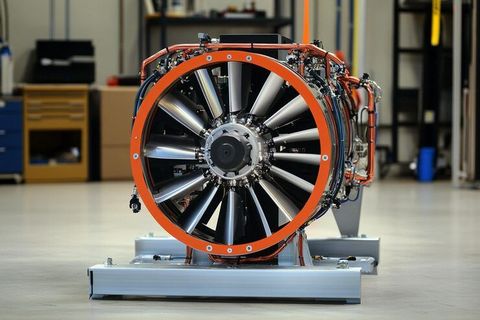
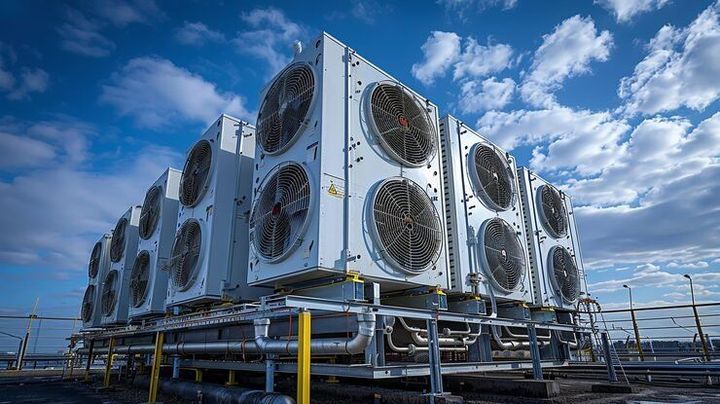
Unlike water cooled chillers, which typically reject heat through a condenser water circuit and cooling tower, air cooled chillers use fans to move outdoor air across condenser coils. This arrangement can simplify system design because a separate cooling tower and its associated water circulation equipment are generally unnecessary.
How Air Cooled Chillers Work
An air cooled chiller removes heat from a circulating liquid, usually water or a water-based mixture, and sends the cooled liquid to equipment or spaces that need temperature control. The liquid absorbs heat as it passes through heat exchangers and returns to the chiller for cooling again.
The refrigeration circuit transfers this collected heat outdoors. Its main stages are evaporation, compression, condensation, and expansion. These stages repeat continuously while the system operates, subject to its controls and cooling demand.
Main Types of Air Cooled Chillers
Air cooled chillers can be classified by compressor design, capacity control, and operating arrangement. Common configurations include:
Scroll chillers, which use scroll-shaped components to compress refrigerant and are commonly found in small and medium-sized systems.
Screw chillers, which use rotating screw-shaped components and are often used in medium or large commercial and industrial applications.
Reciprocating chillers, which compress refrigerant using piston movement and may appear in certain smaller or specialized systems.
Variable-speed chillers, which adjust compressor or fan speed to respond to changing cooling demand.
Modular chillers, which combine multiple units to provide staged capacity and allow the system to respond to different operating loads.
Actual capacity ranges and available configurations vary by manufacturer and model. Selection depends on the cooling load, operating conditions, installation space, and required temperature range.
Importance
Air cooled chillers matter because many buildings and industrial processes generate heat that must be removed to maintain suitable operating conditions. Offices need temperature control for occupants and equipment, while manufacturing facilities may require stable liquid temperatures for production machinery, material processing, or testing operations.
In data centers, cooling helps manage the heat generated by computing equipment. In healthcare and laboratory environments, appropriately designed cooling systems can support environmental control for certain rooms and processes. The required design differs according to the application, and a chiller alone does not provide every environmental control function.
Benefits and Practical Limitations
An air cooled chiller can reduce the need for water-related equipment because its condenser releases heat directly to the outdoor air. This can be useful in locations where water availability is limited or where a cooling tower would create additional installation requirements.
Other potential advantages include a relatively straightforward cooling arrangement, outdoor installation options, and reduced dependence on cooling-tower water treatment. However, air cooled chillers also have limitations that affect their operation.
Outdoor temperature: High ambient temperatures can reduce cooling capacity or increase electricity consumption.
Noise: Condenser fans and compressors produce sound that may affect nearby workspaces or residential areas.
Installation space: Units require sufficient airflow and access for inspection and maintenance.
Energy demand: Compressor and fan operation consume electricity, with actual usage depending on load and conditions.
Weather exposure: Outdoor equipment needs appropriate protection, drainage, and installation clearances.
These factors influence how a system performs throughout the year. A unit that meets a building's cooling demand under one set of conditions may perform differently during hotter weather or at partial load.
Common Applications
Air cooled chillers are used across a range of sectors.
Commercial buildings use them for chilled-water air conditioning.
Manufacturing facilities use them to remove heat from production equipment and selected processes.
Data centers may use chillers as part of a larger cooling arrangement.
Food and beverage facilities may use them for process temperature control, subject to hygiene and process requirements.
Healthcare and laboratory buildings may use them for designated cooling applications.
Industrial equipment installations may use them to control the temperature of machinery, hydraulic systems, or process liquids.
The required design depends on heat generation, operating schedules, fluid requirements, environmental conditions, and the consequences of a cooling interruption.
Recent Updates
Developments in air cooled chiller technology have increasingly focused on energy efficiency, refrigerant selection, variable-speed operation, and digital monitoring. Across the 2024–2026 period, these themes have remained relevant as building operators and industrial facilities assess electricity use, environmental requirements, and equipment performance. The exact features available depend on the manufacturer, model, and local market.
Energy Efficiency and Variable-Speed Controls
Modern chiller designs may use variable-speed compressors, electronically controlled expansion devices, and fan-speed controls to adjust operation to the cooling load. Rather than operating continuously at one output level, these systems can reduce or increase capacity as demand changes.
Efficiency is often described using measures such as the coefficient of performance (COP), energy efficiency ratio (EER), or integrated seasonal performance metrics. These measures are not interchangeable, because they can use different testing conditions and calculation methods. Comparisons are meaningful when equipment is assessed using the same applicable rating standard.
Refrigerant Changes and Environmental Considerations
Refrigerants absorb and release heat as they circulate through the refrigeration system. Some older refrigerants have significant environmental impacts, particularly when released into the atmosphere, so regulatory frameworks have increasingly addressed refrigerant selection, leakage, and phase-down requirements.
Manufacturers may use refrigerants with lower global warming potential (GWP), depending on equipment design and applicable regulations. Refrigerant alternatives can involve different pressure, flammability, toxicity, or handling considerations. Equipment compatibility and qualified installation practices remain important.
Digital Monitoring and Predictive Maintenance
Some chillers include connected controls that record temperatures, pressures, compressor operation, alarms, and energy consumption. Monitoring this information can help facility operators identify unusual operating patterns and plan maintenance activities.
Predictive maintenance tools may analyze equipment data to identify changes that suggest a developing fault. Such tools support inspection and diagnosis but do not eliminate the need for physical checks, correct sensor calibration, or qualified technical assessment.
Laws or Policies
Air cooled chillers are affected by energy-efficiency standards, refrigerant regulations, electrical safety requirements, building rules, and environmental policies. The applicable provisions depend on the equipment category, capacity, refrigerant, installation location, and intended use.
Energy Efficiency and Building Requirements in India
In India, the Bureau of Energy Efficiency (BEE) develops and administers energy-efficiency programs under the Energy Conservation Act, 2001. The Energy Conservation Building Code (ECBC) provides energy-efficiency requirements for covered commercial buildings, with implementation depending on the relevant state or local framework and building applicability.
Specific chiller requirements can depend on the equipment classification and the standards in force. A building owner or facility designer should check the current BEE publications, relevant Indian Standards, and applicable local building regulations rather than assume that every chiller falls under the same labeling or performance requirement.
Refrigerant and Safety Regulations
India's refrigerant policies are influenced by its commitments under the Montreal Protocol, including measures addressing ozone-depleting substances and the phase-down of hydrofluorocarbons under the Kigali Amendment. The specific restrictions and compliance duties depend on the refrigerant, equipment category, and rules currently in force.
Installation and operation may also involve electrical safety, pressure-system precautions, environmental controls, and workplace safety requirements. Technicians need to follow the manufacturer's instructions and applicable regulations when handling refrigerants or working on pressurized equipment. Requirements should be verified for the particular installation.
Tools and Resources
Several technical resources can help building owners, facility managers, and engineering teams understand air cooled chiller requirements. They range from basic cooling-load estimates to equipment selection documents and energy-monitoring systems.
Cooling Calculators and Selection Tools
Cooling-load calculations estimate how much heat a system must remove. The required capacity depends on building size, occupancy, heat-producing equipment, ventilation, outdoor conditions, and process requirements. Simple online calculators can provide preliminary estimates, but detailed installations generally require a more complete engineering assessment.
Manufacturer selection software and product catalogs may provide information about capacity, power consumption, sound levels, operating limits, dimensions, and refrigerant type. These details help compare equipment under stated operating conditions.
Technical Standards and Monitoring Platforms
Useful reference sources include the Bureau of Energy Efficiency website, the Bureau of Indian Standards, and technical publications from the American Society of Heating, Refrigerating and Air-Conditioning Engineers (ASHRAE). These sources provide information about energy efficiency, building systems, refrigeration principles, and applicable technical practices.
Building management systems and chiller controllers can record operating temperatures, alarms, energy consumption, and equipment status. A maintenance log can complement these systems by recording inspection dates, filter and coil condition, refrigerant-related work, unusual noise, and corrective actions.
Main Components and Their Functions
| Component | Main function |
|---|---|
| Evaporator | Transfers heat from the circulating liquid to the refrigerant |
| Compressor | Raises the refrigerant vapor's pressure and temperature |
| Condenser coil | Releases refrigerant heat into outdoor air |
| Condenser fans | Move air across the condenser coil |
| Expansion device | Reduces refrigerant pressure before evaporation |
| Circulation pump | Moves chilled liquid through the connected system |
| Control system | Monitors conditions and regulates operation |
The circulation pump may be supplied separately or integrated into a packaged arrangement. The exact component layout depends on the chiller design.
FAQs
What is an air cooled chiller and how does it work?
An air cooled chiller removes heat from circulating water or another suitable liquid. A refrigeration circuit transfers that heat to refrigerant, and condenser fans release it into outdoor air.
What are the main types of air cooled chillers?
Common types include scroll, screw, and reciprocating compressor chillers, along with modular and variable-speed configurations. The appropriate design depends on cooling capacity, operating conditions, and the required level of control.
What are the main benefits of air cooled chillers?
They generally do not require a separate cooling tower or condenser-water circuit. This can simplify installation and reduce cooling-tower water requirements, although electricity use, noise, and outdoor temperature remain important considerations.
How is an air cooled chiller different from a water cooled chiller?
An air cooled chiller releases condenser heat directly into outdoor air. A water cooled chiller typically transfers heat to condenser water, which then rejects heat through a cooling tower or another heat-rejection arrangement.
How can air cooled chiller energy efficiency be evaluated?
Efficiency can be assessed using published COP, EER, or applicable seasonal performance ratings. Comparisons should use consistent testing conditions, while actual energy use should be evaluated against the site's cooling demand and operating environment.
Conclusion
Air cooled chillers remove heat from circulating liquids by using a refrigeration circuit and outdoor air for heat rejection. Their types, components, efficiency, and applications vary according to cooling demand and installation conditions. Recent developments emphasize variable-speed controls, lower-impact refrigerants, and digital monitoring, while applicable energy and environmental regulations influence equipment selection and operation. Understanding these factors provides a useful foundation for evaluating chiller systems in commercial and industrial settings.