Robotics in Industrial Automation Guide: Designs, Functions, Uses and Key Features
Robotics in industrial automation refers to the use of programmable machines to perform manufacturing and industrial tasks with limited direct human involvement. These robots can move materials, assemble components, inspect products, weld metal, package goods, and carry out repetitive operations.
Context
Robotics in industrial automation refers to the use of programmable machines to perform manufacturing and industrial tasks with limited direct human involvement. These robots can move materials, assemble components, inspect products, weld metal, package goods, and carry out repetitive operations. A Robotics in Industrial Automation Guide explains robot designs, functions, industrial uses, and key features to help readers understand how these systems operate.
Industrial robotics developed alongside advances in mechanical engineering, electrical controls, and computer technology. Early industrial robots were designed mainly for repetitive manufacturing operations, including material handling and welding. As sensors, computing systems, and control software developed, robots became capable of handling more varied tasks and responding to information from their surroundings.
Today, industrial robots are used in automotive production, electronics manufacturing, food processing, metal fabrication, pharmaceutical production, and warehouse operations. Their configurations differ according to the task, the required movement, the working environment, and the level of precision needed.
Main Designs of Industrial Robots
Industrial robots come in several mechanical designs, each suited to particular movements and applications.
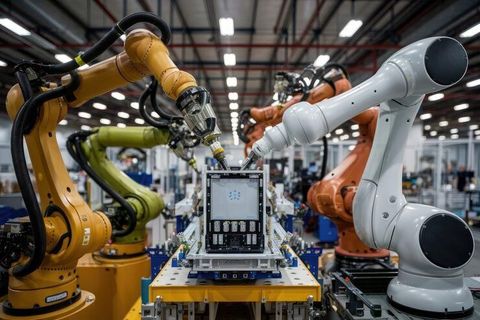
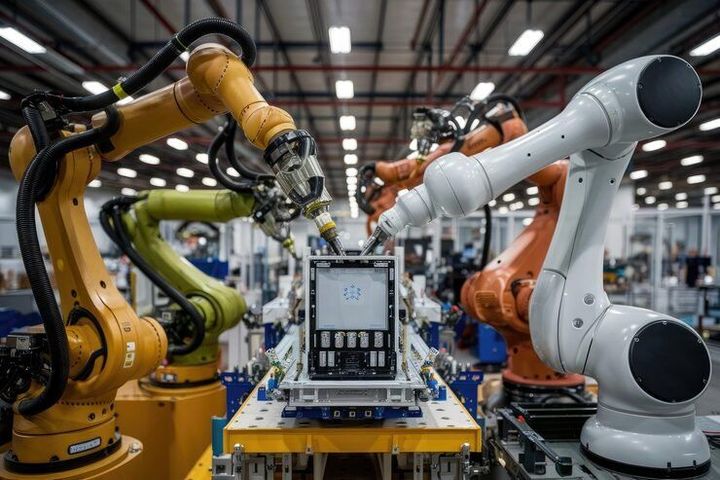
Articulated robots: These robots use several rotary joints connected by movable arms. They can perform tasks such as welding, painting, assembly, and machine tending.
Cartesian robots: These systems move along straight linear axes, commonly arranged at right angles. They are used in pick-and-place operations, material positioning, and automated production equipment.
SCARA robots: Selective Compliance Assembly Robot Arm systems combine rotary joints and vertical movement. They are often used for small-part assembly, component insertion, and electronics production.
Delta robots: These robots use connected arms arranged around a supporting frame. Their lightweight moving structures make them suitable for rapid sorting and packaging of relatively light objects.
Cylindrical robots: These systems combine rotary movement with linear movement to operate within a roughly cylindrical workspace.
Collaborative robots: Commonly called cobots, these robots are designed to work near people when the complete application has been assessed and configured for safe operation.
Each design has different movement capabilities, workspace requirements, payload limits, and installation needs. The selected configuration depends on the physical demands of the production process.
Importance
Robotics in industrial automation matters because manufacturing processes often require repeated movements, consistent positioning, controlled material handling, and continuous monitoring. Robots can perform many repetitive or physically demanding tasks, helping industrial facilities organize production activities and manage certain operational risks.
These systems affect manufacturers, equipment operators, maintenance teams, engineers, and consumers. Their use can influence product consistency, production schedules, workplace arrangements, and the skills required to operate modern industrial facilities.
Functions of Industrial Robots
Industrial robots perform tasks through programmed movements, control systems, and information collected from sensors. Their main functions include the following.
Material handling: Moving raw materials, components, or finished products between production stages.
Welding and cutting: Following programmed paths to join or separate materials using appropriate tools.
Assembly: Positioning and joining components according to specified sequences.
Machine tending: Loading and unloading machines such as CNC machining centers and injection molding equipment.
Inspection: Using cameras, sensors, or measuring devices to identify visible defects and check dimensions.
Painting and coating: Applying materials along controlled paths in suitable, properly protected work environments.
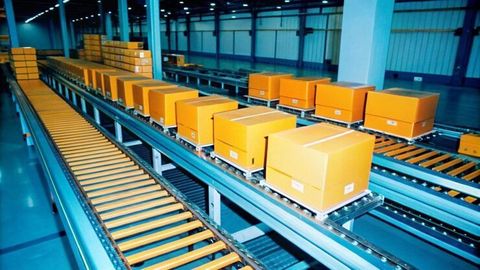
Packaging and palletizing: Sorting products, placing them into containers, and arranging packages for storage or transport.
A robot usually operates as part of a larger production system. Conveyors, machine tools, sensors, safety equipment, and supervisory software may all be required for the complete process to function correctly.
Key Features of Industrial Automation Robots
Industrial robots have several technical features that determine their capabilities and operating requirements.
Payload capacity describes the mass a robot can carry within its specified operating limits. Reach describes how far the robot can extend into its workspace, while repeatability describes how consistently it can return to a previously programmed position.
Other important features include movement speed, the number of controllable axes, programming options, sensor compatibility, and communication interfaces. Environmental ratings can also matter when robots operate in dusty areas, wet production environments, or locations with elevated temperatures.
| Feature | Meaning | Industrial relevance |
|---|---|---|
| Payload | Supported load within specified limits | Handling components and tools |
| Reach | Extent of the working area | Positioning parts across a workstation |
| Repeatability | Consistency when returning to a position | Assembly and inspection |
| Degrees of freedom | Available independent movements | Reaching different angles and positions |
| Sensors | Devices that collect information | Detecting objects and monitoring conditions |
| Control system | Hardware and software governing movement | Coordinating programmed operations |
| Safety functions | Measures that reduce operational risks | Managing interaction with people and equipment |
The specifications of an individual robot must be considered together. A robot's payload, for example, can be affected by the mass of its end tool, the position of the load, and the required movement.
Recent Updates
Industrial robotics continues to develop through improvements in sensing, software, connectivity, and artificial intelligence. Current developments across 2024–2026 include greater attention to flexible automation, easier programming, data-based maintenance, and coordination between robots and other factory equipment. Adoption varies according to the industry, facility requirements, and available technical expertise.
Artificial Intelligence and Machine Vision
Traditional industrial robots generally follow programmed instructions, while newer systems can incorporate machine vision and AI-based tools to interpret images, classify objects, or support inspection. These capabilities can help systems manage variations in object position or appearance when the application has been properly trained and validated.
AI does not eliminate the need for engineering controls. Performance depends on lighting, sensor quality, training data, object variation, and the consequences of an incorrect decision. Critical processes may require additional inspection steps and independent safety measures.
Collaborative and Flexible Robotics
Collaborative robots are increasingly discussed in applications where people and automated equipment share a work area. Depending on the design and risk assessment, they can support assembly, testing, packaging, and machine tending. However, a collaborative label alone does not mean that every installation is safe for direct human contact.
Flexible automation is another important development. Manufacturers may use reprogrammable robots, interchangeable grippers, and standardized communication interfaces to adapt equipment when products or production requirements change.
Connected Factories and Predictive Maintenance
Connected industrial systems can collect information about operating hours, motor loads, vibration, temperature, and production interruptions. Maintenance teams can analyze these measurements to identify unusual patterns and investigate possible equipment problems before they cause significant disruption.
Predictive maintenance depends on reliable data, suitable analysis, and appropriate maintenance procedures. It does not identify every failure in advance, and conventional inspection and scheduled maintenance may still be necessary.
Laws or Policies
Industrial robotics is governed by workplace safety requirements, machinery regulations, electrical standards, and applicable industry-specific rules. The relevant framework depends on the country, the type of equipment, the workplace, and the task being performed.
Industrial Robot Safety Standards
International standards provide guidance for designing, integrating, and operating industrial robot systems. ISO 10218 addresses industrial robot safety, including requirements related to robots and their integration into applications. ISO/TS 15066 provides additional guidance for collaborative robot applications.
These standards are not automatically laws in every country. Their legal relevance depends on local adoption, applicable regulations, contracts, and industry requirements. A complete risk assessment should consider the robot, grippers, workpieces, surrounding machinery, and the behavior of people in the working area.
Typical protective measures include physical barriers, interlocked gates, emergency stops, presence-sensing devices, restricted movement zones, and appropriate maintenance procedures. The necessary combination depends on the assessed risks and the equipment configuration.
Industrial Robotics in India
In India, industrial robot installations may be affected by the Factories Act, 1948, where applicable, along with relevant state factory rules, occupational safety requirements, electrical regulations, and machinery-specific standards. India's Occupational Safety, Health and Working Conditions Code, 2020, is also part of the country's evolving occupational safety framework; its applicability depends on commencement and the rules in force.
Manufacturers and factory operators need to determine which requirements apply to their specific facilities. Relevant considerations include machine guarding, worker training, electrical isolation, maintenance access, and safe procedures for clearing faults or removing jammed materials.
Government initiatives supporting manufacturing, automation, and industrial modernization can also influence technology adoption. However, eligibility for a particular scheme or incentive depends on its current rules and the circumstances of the participating organization.
Tools and Resources
Several technical tools help industrial teams plan robot installations, develop programs, test movements, and monitor production performance. The appropriate tools depend on the robot manufacturer, control system, and intended application.
Robot Simulation and Programming
Robot simulation software allows engineers to model workspaces, movement paths, cycle sequences, and possible collisions before installing equipment. Examples include ABB RobotStudio, FANUC ROBOGUIDE, and Siemens Process Simulate. Supported features differ by product, robot model, and software version.
Simulation can help evaluate reach, identify interference between equipment, and organize workstation layouts. Physical commissioning and safety validation are still required because a digital model may not capture every real-world condition.
Sensors and Production Monitoring
Machine vision systems, proximity sensors, force sensors, and measurement devices provide information about objects and operating conditions. Industrial controllers use this information to coordinate robot actions with other machines and production equipment.
Manufacturing execution systems and industrial monitoring platforms can record production quantities, machine status, downtime, and quality information. These records help teams understand process performance and investigate recurring problems.
Planning and Evaluation Resources
Before introducing industrial robotics, a facility may document:
The task and expected production sequence.
Required payload, reach, precision, and cycle time.
Grippers, fixtures, sensors, and supporting machinery.
Safety risks and protective measures.
Programming, operator training, and maintenance requirements.
Integration with existing controls and production records.
Equipment manuals, manufacturer documentation, relevant ISO standards, and applicable government regulations provide additional technical information. The final system design should account for the complete work process rather than the robot alone.
FAQs
What is robotics in industrial automation?
Robotics in industrial automation uses programmable machines to perform manufacturing tasks such as welding, assembly, material handling, inspection, and packaging. These robots generally operate as part of a larger automated production system.
What are the main types of industrial robots?
The main types include articulated, Cartesian, SCARA, delta, cylindrical, and collaborative robots. Each type has different movement characteristics and is suited to particular tasks and workspace requirements.
What are the key features of industrial automation robots?
Important features include payload capacity, reach, repeatability, movement speed, degrees of freedom, sensor compatibility, programming capabilities, and safety functions. Their importance depends on the task and operating environment.
How is AI used in industrial robotics?
AI can support image recognition, object classification, visual inspection, adaptive handling, and analysis of equipment data. Its effectiveness depends on the application, data quality, system validation, and appropriate safety controls.
What safety rules apply to industrial robots in India?
Applicable requirements may include factory and occupational safety laws, state rules, electrical regulations, and relevant machinery standards. The exact requirements depend on the facility, equipment, work process, and regulations in force.
Conclusion
Robotics in industrial automation combines mechanical design, programming, sensors, and control systems to carry out a wide range of industrial tasks. Robot types differ in movement, payload, reach, and suitability for particular production processes. Developments in AI, machine vision, connected equipment, and flexible programming continue to expand industrial applications. Safe and effective integration depends on suitable system design, worker training, maintenance, and compliance with applicable regulations.