Concrete Mixers Discover: Types, Components, Mixing Processes, Uses and Selection Factors
Concrete mixers are machines used to combine cement, water, sand, aggregates, and sometimes approved admixtures into a workable concrete mixture. They are used on building sites, road projects, precast operations, and other construction activities where ingredients need to be mixed in a controlled manner. Concrete mixers range from compact portable units to large systems integrated with batching plants.
Before mechanical mixers became common, concrete was often mixed manually or with basic equipment. As construction projects became larger, the need for more consistent mixing, faster production, and controlled material handling encouraged the development of mechanical concrete mixers.
The basic principle remains straightforward. Ingredients are placed into a mixing chamber or drum, mechanical movement combines the materials, and the resulting concrete is discharged for placement. Different mixer designs use different movements, blades, drums, or paddles to achieve the required mixing action.
How Concrete Mixers Work
A typical concrete mixer has a container that holds the ingredients and a mechanism that moves them. Depending on the design, the drum may rotate while fixed blades move the material, or internal paddles may mix the ingredients within a stationary chamber.
The mixing process generally involves several stages: measuring the ingredients, loading them into the mixer, adding water and admixtures when required, mixing for an appropriate period, and discharging the concrete. The sequence can vary according to the mixer type, concrete specification, and production method.
Main Components
Although designs differ, many concrete mixers contain similar basic components:
- Mixing drum or chamber for holding materials
- Blades, paddles, or internal mixing elements
- Motor or engine for producing mechanical movement
- Transmission or drive system for transferring power
- Frame or supporting structure
- Loading and discharge arrangements
- Controls for starting, stopping, and adjusting operation
The size and arrangement of these components influence the mixer’s capacity, mixing action, mobility, and operating requirements.
Importance
Concrete mixers matter because concrete is used in foundations, floors, columns, roads, bridges, drainage structures, pavements, and many other forms of infrastructure. Consistent mixing helps distribute cement paste, water, aggregates, and other ingredients throughout the batch.
Poor mixing can create uneven material distribution. This may affect workability and the uniformity of concrete placed in different parts of a project. For this reason, mixing is one part of a wider concrete production process that also includes proportioning, material quality, placement, compaction, and curing.
Concrete mixers also affect the way construction teams organize their work. A small building project may require a compact batch mixer, while a large infrastructure project can use a continuous or plant-based mixing arrangement. Choosing an appropriate machine therefore depends on production requirements rather than simply physical size.
Types of Concrete Mixers
Concrete mixers can be grouped according to their mixing method, mobility, and production arrangement.
| Mixer type | General characteristic | Common application |
|---|---|---|
| Drum mixer | Rotating drum mixes ingredients | Building and general construction |
| Tilting drum mixer | Drum can tilt for discharge | Small and medium batches |
| Non-tilting drum mixer | Drum remains in a fixed position | Controlled batch production |
| Pan mixer | Materials mix in a shallow pan | Precast products and specialized concrete |
| Twin-shaft mixer | Two shafts work together | Large-volume concrete production |
| Planetary mixer | Mixing tools rotate around multiple paths | Precast and specialized mixes |
| Continuous mixer | Materials enter and discharge continuously | Certain road and infrastructure applications |
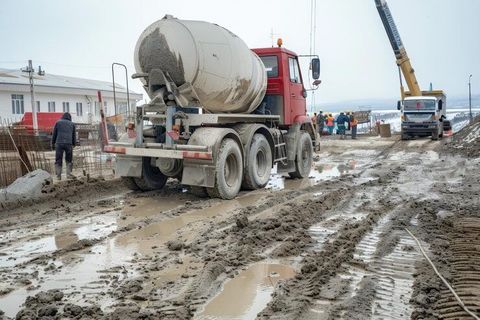
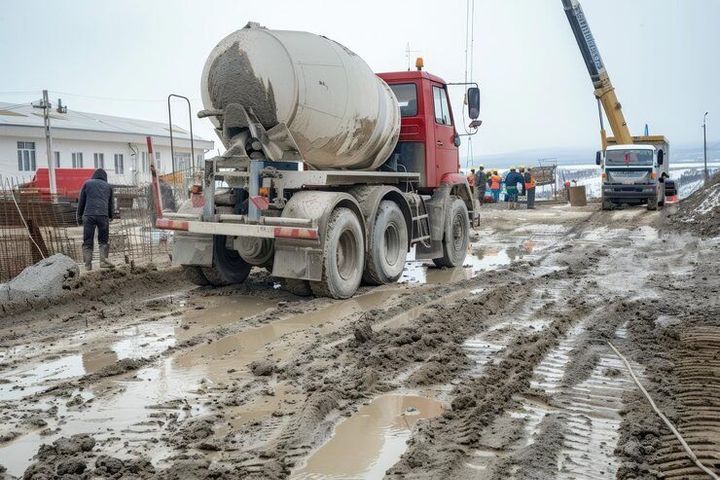
| Truck mixer | Rotating drum mounted on a vehicle | Transport and mixing of ready-mixed concrete |
Portable and Stationary Systems
Portable concrete mixers are designed to be moved between locations. They are useful where concrete is prepared close to the placement area and production requirements are relatively moderate.
Stationary mixers are installed at a fixed location and can form part of a batching or concrete production system. These arrangements are generally associated with projects requiring repeated and controlled batches.
Components and Mixing Processes
The performance of a concrete mixer depends on how its components work together. The mixing chamber determines the available space, while blades or paddles create the movement needed to distribute materials.
The drive system supplies mechanical power. Controls allow operators to start and stop the equipment and, depending on the design, manage operating conditions. Discharge arrangements determine how mixed concrete leaves the machine.
Typical Mixing Process
A general concrete mixing process can be described as follows:
- Materials are measured according to the selected concrete mix proportions.
- Aggregates and cementitious materials are introduced into the mixer.
- Water and applicable admixtures are added according to the specified mixture.
- Mixing elements move the materials through the chamber.
- The mixture is checked for the required consistency and uniformity.
- Concrete is discharged for placement or transferred to the next stage.
The exact sequence can differ between equipment types. Concrete mix proportioning should follow the applicable design and project requirements rather than relying on a generic ingredient ratio.
Factors Affecting Mixing
Several factors influence the resulting mixture. These include mixing time, drum or chamber geometry, blade arrangement, batch size, material moisture, aggregate characteristics, and water quantity.
Overloading a mixer can interfere with material movement. Inadequate mixing can also result in uneven distribution. Operators therefore need to follow the equipment manufacturer’s operating instructions and the applicable concrete specification.
Uses and Selection Factors
Concrete mixers are used across many construction activities. Their applications include building foundations, residential construction, commercial structures, road works, drainage projects, precast components, repair work, and infrastructure development.
The appropriate mixer depends on the project rather than on one universal specification.
Important Selection Factors
Capacity is one consideration. The required batch size should correspond with the amount of concrete needed during a particular work cycle. A mixer that is too small may require many batches, while excessive capacity may not suit a small project.
Mixing method is another factor. Drum mixers, pan mixers, twin-shaft mixers, and planetary mixers create different mixing actions. The selected design should correspond with the concrete type and production arrangement.
Mobility also matters. Portable equipment can be relocated between work areas, whereas stationary equipment is intended for fixed production locations.
Power requirements should also be considered. Mixers may use electric motors, diesel engines, or other drive arrangements. Available electrical supply, site conditions, operating environment, and equipment controls can influence the appropriate configuration.
Maintenance access is another practical consideration. Components such as blades, paddles, bearings, drive elements, and discharge mechanisms require inspection according to the equipment instructions. Easy access can simplify routine checks.
Safety features are equally important. Guards, emergency stopping arrangements, stable foundations, electrical protection, and appropriate operator procedures help reduce operational risks.
Recent Updates
Concrete mixing equipment has continued to develop alongside broader changes in construction equipment and concrete production. One notable development in India is the publication of IS 4925:2023, which specifies requirements for concrete batching and mixing plants. BIS records the standard as the second revision of the earlier specification.
Digital controls and automated batching systems are also increasingly associated with modern concrete production. These systems can help monitor material quantities, operating parameters, batch records, and production consistency. The level of automation varies considerably between individual machines and plants.
Another current trend is greater attention to material efficiency and environmental management. Concrete production can involve significant quantities of cementitious materials, aggregates, water, wash water, and construction residues. This has increased attention toward controlled material handling, water management, waste reduction, and the use of appropriate recycled materials where project specifications permit.
India has also moved toward stronger construction and demolition waste management. The Environment (Construction and Demolition) Waste Management Rules, 2025 superseded the earlier 2016 framework and came into force on 1 April 2026. The revised framework includes measures concerning waste management, utilization, environmental compensation, online monitoring, and resource efficiency.
Laws or Policies
In India, concrete mixer operation is affected by several layers of construction, environmental, workplace, and local requirements. The exact requirements can vary according to the project, location, equipment type, and whether the mixer is part of a larger concrete plant.
Bureau of Indian Standards publications are particularly relevant to concrete production. IS 4926:2003 provides a code of practice for ready-mixed concrete, while IS 10262:2019 provides guidelines for concrete mix proportioning. BIS also identifies standards concerning concrete mixers and batching and mixing plants.
Environmental rules are also relevant when concrete production generates wastewater, residue, dust, or construction and demolition waste. The 2025 C&D Waste Management Rules apply to construction, demolition, remodeling, renovation, and repair activities, with specified exclusions.
The BIS certification framework also includes process certification for ready-mixed concrete based on IS 4926. BIS documentation addresses areas such as water management, waste management, material handling, delivery records, and environmental practices.
Project operators may also need to consider state pollution control requirements, local authority rules, workplace safety requirements, electrical regulations, and site-specific environmental conditions. Requirements should therefore be checked against the particular project and jurisdiction.
Tools and Resources
Several technical resources can help readers understand concrete mixers and concrete production.
The BIS Know Your Standard portal allows users to search Indian Standards by IS number or keyword and access information about standards, amendments, related documents, laboratories, and certification details.
Concrete mix proportioning references can help explain the relationship between cementitious materials, aggregates, water, and admixtures. IS 10262 is one relevant Indian reference for concrete mix proportioning, while IS 4926 provides guidance related to ready-mixed concrete.
Useful practical resources include:
- Concrete volume calculators for estimating required concrete quantities
- Unit-conversion tools for understanding capacity and material measurements
- Equipment manuals for operating limits and maintenance intervals
- Concrete mix design references for proportioning principles
- BIS publications for applicable Indian Standards
- Local pollution control authority resources for environmental requirements
- Project specifications and engineering documents for application-specific requirements
Calculators can assist with preliminary quantity estimates, but final concrete proportions should follow the relevant project specification and applicable engineering requirements.
FAQs
What is a concrete mixer?
A concrete mixer is equipment that mechanically combines cement, water, fine aggregate, coarse aggregate, and applicable admixtures into a concrete mixture. Different mixer designs use drums, paddles, blades, or other mixing mechanisms.
What are the main types of concrete mixers?
Common types include drum mixers, tilting drum mixers, non-tilting drum mixers, pan mixers, twin-shaft mixers, planetary mixers, continuous mixers, and truck mixers. Each type has a different mixing arrangement and may suit different production conditions.
How does a concrete mixer work?
A concrete mixer works by moving concrete ingredients through a rotating drum or mixing chamber. The movement created by blades, paddles, or the chamber itself distributes the materials and produces a more uniform mixture.
What factors should be considered when selecting a concrete mixer?
Important factors include batch capacity, mixing method, mobility, power requirements, material characteristics, discharge arrangement, maintenance access, safety features, and the required production pattern. Project specifications and applicable standards should also be considered.
What standards apply to concrete mixers in India?
Relevant Indian Standards include IS 4925 for concrete batching and mixing plants, IS 4926 for ready-mixed concrete, and IS 10262 for concrete mix proportioning. The specific standards applicable to a project depend on the equipment and concrete production method.
Conclusion
Concrete mixers provide a mechanical method for combining concrete ingredients into a workable and more uniform mixture. Their designs range from portable drum units to specialized mixers used in larger production systems. Capacity, mixing method, mobility, power requirements, safety, and maintenance are important factors when understanding different equipment options. In India, concrete production is also influenced by BIS standards and environmental requirements, including the construction and demolition waste framework that became effective in 2026.