Diamond Necklace Knowledge: Designs, Diamond Characteristics, Settings, Lengths and Features
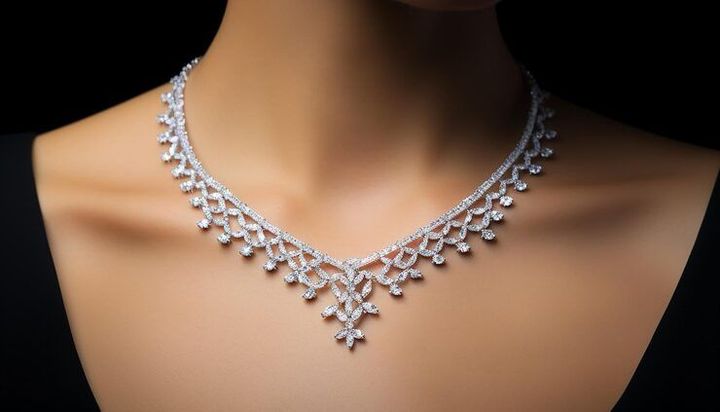
A diamond necklace is a piece of jewellery that combines diamonds with a metal framework to create a decorative design worn around the neck. Diamond necklaces can range from simple chains with a single stone to elaborate arrangements containing many diamonds in different shapes, settings, and patterns. Understanding diamond necklace knowledge involves looking at designs, diamond characteristics, settings, lengths, metal choices, and construction features.
Diamonds have been used in jewellery for centuries, while modern diamond grading has developed more systematic ways to describe their characteristics. The commonly used 4Cs—color, clarity, cut, and carat weight—provide a standardized framework for describing important diamond properties. The Gemological Institute of America explains that these four factors describe different aspects of a diamond, including its color, internal and external characteristics, proportions and appearance, and weight.
A necklace may contain natural diamonds, laboratory-grown diamonds, treated diamonds, or other diamond-like materials. These categories are different and should be identified clearly. In India, the Bureau of Indian Standards introduced IS 19469:2025, which addresses consumer understanding and clear descriptions of natural, laboratory-grown, treated, composite, and imitation diamond products.
Importance
Understanding diamond necklace features can help people interpret jewellery descriptions and compare different designs using consistent information. A necklace's appearance depends not only on the diamonds but also on the arrangement of stones, metal color, setting structure, chain length, clasp, and overall construction.
Diamond characteristics are also important because two diamonds with similar dimensions may differ in color, clarity, cut, and weight. Carat measures weight rather than visual size alone; one metric carat equals 0.2 grams. Two diamonds with the same carat weight can have different characteristics because of differences in cut, color, and clarity.
Several practical factors affect everyday use:
- Design: Determines the overall visual arrangement and style of the necklace.
- Diamond characteristics: Describe properties such as cut, color, clarity, and carat weight.
- Setting: Holds each diamond in position and affects how much of the stone is visible.
- Length: Influences where the necklace rests on the neck and upper chest.
- Metal: Provides the structural framework and contributes to the necklace's appearance.
- Clasp and construction: Affect how the necklace is fastened and how its components are connected.
Understanding these elements can also make jewellery terminology easier to interpret when reading product descriptions, grading reports, or educational material.
Recent Updates
Greater attention to diamond identification
From 2024 through 2026, the diamond sector has continued to place greater attention on distinguishing natural diamonds from laboratory-grown diamonds. Laboratory-grown diamonds have the same basic chemical composition and crystal structure as natural diamonds, but their origins are different. Clear terminology is therefore increasingly important when describing jewellery.
India's IS 19469:2025 specifically addresses consumer confidence in the diamond industry and establishes guidance for describing natural, laboratory-grown, treated, composite, and imitation products. The standard is intended to reduce confusion by requiring appropriate terminology and disclosure.
Continued development of digital information
Digital access to standards and jewellery-related information has also expanded. The BIS "Know Your Standard" platform allows users to search Indian Standards by standard number or product-related keyword and access information about standards, amendments, laboratories, and related documentation.
The BIS Care app also provides a HUID verification feature for applicable hallmarked gold jewellery. This creates a digital method for checking hallmark-related information associated with a jewellery item.
Changing diamond shapes and materials
Industry reports during this period have described continued interest in different diamond shapes and laboratory-grown diamond jewellery. One 2025 industry report noted that round diamonds remained a major category while oval shapes represented a growing share in the reported market data. Such figures describe particular market samples and should not be treated as universal preferences.
These developments mean that modern diamond necklace knowledge increasingly includes not only traditional design and diamond grading but also origin terminology, documentation, and digital verification.
Laws or Policies
Hallmarking in India
In India, hallmarking regulations primarily concern the purity or fineness of precious metals such as gold and silver rather than the diamond itself. BIS explains that hallmarking records the proportion of precious metal in an article and provides an official indication of its fineness.
For a diamond necklace made with gold, the applicable gold hallmarking requirements are therefore relevant to the metal component. BIS states that gold jewellery can be covered by permitted fineness grades such as 14K, 18K, 20K, 22K, 23K, and 24KS/995, subject to the applicable standards and requirements.
HUID verification
Applicable hallmarked gold jewellery carries a Hallmark Unique Identification number, commonly called HUID. The BIS Care app includes a "Verify HUID" feature that allows consumers to check information associated with hallmarked gold jewellery.
Changes to hallmarking coverage
India's mandatory hallmarking framework has been amended periodically. The BIS mandatory hallmarking page lists amendments covering 2024, 2025, and 2026, showing that the district coverage and regulatory framework continue to be updated.
It is important to distinguish metal hallmarking from diamond grading. A gold hallmark does not itself describe the diamond's color, clarity, cut, carat weight, or geological origin. Those characteristics require separate diamond-related documentation or grading information.
Diamond description standards
IS 19469:2025 provides guidance concerning descriptions and disclosures for diamond and diamond-like products. It distinguishes natural diamonds from laboratory-grown, treated, composite, and imitation products and emphasizes clear terminology.
Rules and standards can change, so current BIS requirements should be checked when interpreting a particular necklace's regulatory status.
Tools and Resources
Diamond grading reports
A diamond grading report can provide structured information about a diamond's characteristics. GIA reports, for example, can include the 4Cs: color, clarity, cut, and carat weight. For applicable round brilliant diamonds, a cut grade may also be provided.
Diamond 4Cs references
The 4Cs are useful for understanding basic diamond terminology. Color generally describes the degree of colorlessness, clarity refers to inclusions and blemishes, cut evaluates proportions and related optical characteristics, and carat weight measures diamond weight.
BIS Care app
The BIS Care app provides access to several BIS-related functions, including HUID verification for applicable hallmarked gold jewellery and information about Indian Standards.
Diamond measurements and comparison tables
Simple comparison tables can help readers understand necklace specifications without relying on visual descriptions alone.
| Feature | What it describes | Common examples |
|---|---|---|
| Diamond shape | Outline of the diamond | Round, oval, pear, marquise, heart |
| Cut | Facet arrangement and proportions | Round brilliant cut grades |
| Color | Degree of body color | D–Z for many standard diamonds |
| Clarity | Internal and external characteristics | FL, IF, VVS, VS, SI, I |
| Carat | Diamond weight | 0.25 ct, 0.50 ct, 1.00 ct |
| Setting | Method used to hold the diamond | Prong, bezel, pavé, channel |
| Necklace length | Approximate placement around the neck | Choker, princess, matinee, opera |
| Metal | Main structural material | Gold, platinum, silver |
Necklace lengths
Necklace length affects its position on the body. Common categories include choker lengths, which sit relatively close to the neck; princess lengths, which generally fall around the upper chest; matinee lengths, which extend farther down the chest; and opera lengths, which are longer.
Actual placement varies according to neck size, chain construction, pendant dimensions, and personal styling. Measurements are therefore more precise than relying only on category names.
Common diamond necklace designs
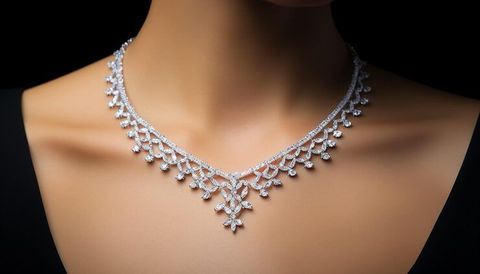
Diamond necklace designs can be grouped according to the arrangement of stones. A solitaire necklace generally centers attention on one primary diamond. A pendant necklace uses a diamond or diamond arrangement attached to a central pendant. A tennis-style necklace uses a continuous sequence of stones arranged around much of the necklace.
Other designs include station necklaces, where individual diamond units are separated along a chain, and graduated necklaces, where stone sizes change progressively across the design. Floral, geometric, cluster, and halo arrangements create different visual patterns by combining multiple stones.
Common settings
The setting determines how a diamond is secured within the jewellery structure. Prong settings use small metal supports around the stone, while bezel settings surround the stone's edge with metal. Pavé settings place multiple small stones closely together, creating a continuous diamond-covered appearance.
Channel settings hold stones between metal rails, while cluster settings group several diamonds closely around a central area. Each structure has different visual and construction characteristics, so the setting is an important part of diamond necklace knowledge.
FAQs
What are the main diamond characteristics in a diamond necklace?
The main characteristics are commonly described through the 4Cs: color, clarity, cut, and carat weight. These factors provide a standardized vocabulary for discussing important diamond properties.
What diamond necklace lengths are commonly used?
Common length categories include choker, princess, matinee, and opera. The actual position of a necklace depends on its measured length and the wearer's neck and body proportions.
How do diamond necklace settings differ?
Prong, bezel, pavé, channel, and cluster settings use different structures to hold diamonds. They also create different visual patterns and levels of metal visibility.
Does a gold hallmark describe the diamond?
No. A gold hallmark primarily identifies the fineness of the gold component. Diamond characteristics such as color, clarity, cut, and carat weight are separate attributes and may be documented through a diamond grading report.
What is the difference between natural and laboratory-grown diamonds?
Natural diamonds form through geological processes, while laboratory-grown diamonds are produced through technological processes. Their origins are different, so clear identification is important when describing diamond jewellery. India's IS 19469:2025 provides terminology and disclosure guidance for these categories.
Conclusion
Diamond necklace knowledge includes several connected elements, including design, diamond characteristics, settings, necklace lengths, metals, and construction details. The 4Cs provide a common framework for understanding diamond properties, while settings and lengths help explain the physical design of a necklace. In India, gold hallmarking and newer diamond-description standards provide additional information about metal purity and diamond identity. Current educational resources from GIA and BIS can help readers understand grading terminology, standards, and verification processes.