Factory Automation Guide: Types, Components, Processes, Applications and Efficiency Factors
Factory automation is the use of machines, control systems, software, sensors, and connected equipment to carry out production activities with limited manual intervention. It developed from mechanical production methods and later expanded through electrical controls, programmable systems, industrial robots, computers, and connected networks. Today, factory automation can range from a single automated machine to a connected production line that monitors equipment and production data.
The main purpose is to make repeatable production activities more consistent, measurable, and easier to control. Automation does not mean that people disappear from a factory. People commonly define production requirements, monitor systems, handle exceptions, maintain equipment, inspect results, and make process decisions.
What factory automation includes
A factory automation system may contain several layers that work together. Sensors gather information, controllers interpret signals, machines perform physical actions, and software displays or analyzes information. Communication networks connect these parts so that data can move between equipment and supervisory systems.
Common elements include:
- Sensors for temperature, pressure, position, speed, level, or presence
- Programmable logic controllers, commonly called PLCs
- Human-machine interfaces, or HMIs, for viewing and controlling processes
- Motors, drives, valves, actuators, and other mechanical devices
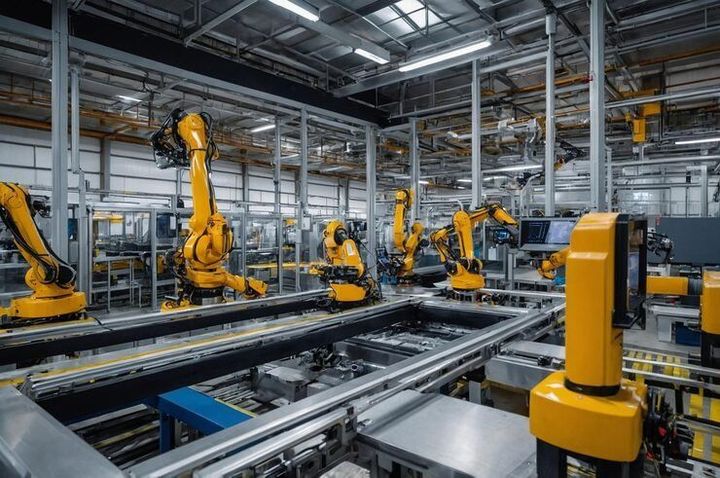
- Industrial robots and automated material-handling equipment
- Supervisory control and data acquisition, or SCADA, systems
- Manufacturing execution systems, or MES, for production information
- Industrial communication networks and data platforms
Importance
Factory automation matters because manufacturing involves repeated movements, precise timing, continuous monitoring, and coordination among many machines. Manual operation can be suitable for some activities, but repetitive or closely timed processes can become difficult to manage consistently as production becomes more complex.
Automation can help address practical factory challenges such as process variation, equipment downtime, manual data recording, material movement, and monitoring of difficult environments. Its effects can also reach people outside the factory because manufacturing processes influence the availability, consistency, and traceability of products used in everyday life.
Who uses factory automation
Automation is used across industries with different production patterns. Examples include automotive manufacturing, electronics, food processing, packaging, chemicals, pharmaceuticals, metalworking, textiles, logistics, and energy-related equipment.
The appropriate level of automation depends on the process. A small operation may use a single PLC-controlled machine, while a large plant may connect robots, conveyors, inspection systems, production software, and data platforms.
Efficiency factors
Efficiency is not determined by automation alone. Important factors include equipment availability, cycle time, changeover time, material flow, energy use, maintenance practices, quality checks, data accuracy, and worker training.
A useful way to study performance is to measure several indicators together. For example, overall equipment effectiveness, often called OEE, considers availability, performance, and quality. These measures can help explain whether a production line is losing time, operating below its intended rate, or producing unacceptable output.
| Factor | What it measures | Example focus |
|---|---|---|
| Availability | Operating time compared with planned time | Downtime and stoppages |
| Performance | Actual production rate compared with a reference rate | Cycle time |
| Quality | Acceptable output compared with total output | Defects and rework |
| Energy use | Energy consumed during production | Motors and heating |
| Changeover | Time needed to switch production settings | Tool or material changes |
Recent Updates
From 2024 through 2026, factory automation in India has increasingly been discussed alongside Industry 4.0, robotics, artificial intelligence, digital twins, connected equipment, and data-based production management. Government-supported manufacturing initiatives have continued to develop demonstration facilities, training programs, digital maturity assessments, and Industry 4.0 use cases.
The Ministry of Heavy Industries has continued work through SAMARTH Udyog Bharat 4.0 centres. By 2026, these centres were reported as supporting industrial awareness and training activities, while additional Industry 4.0 experience centres were being developed across India.
Another noticeable trend is the wider connection between automation and data. Modern systems can collect machine information, combine it with production records, and use analytics to identify patterns. Artificial intelligence and machine learning are increasingly discussed for areas such as predictive maintenance, visual inspection, process monitoring, and production planning.
Robotics has also received continued policy attention. In 2026, a government Technology Advisory Group discussed the Indian robotics ecosystem and a strategic roadmap for robotics and advanced manufacturing. NITI Aayog's 2025 advanced manufacturing roadmap also identified artificial intelligence and machine learning, digital twins, and robotics among technologies relevant to manufacturing development.
These developments do not mean that every factory needs the same technology. Automation levels continue to vary according to production volume, process complexity, safety requirements, existing equipment, workforce capabilities, and the type of data available.
Laws or Policies
In India, factory automation is influenced by occupational safety requirements, electrical safety rules, machinery standards, and sector-specific regulations. The Occupational Safety, Health and Working Conditions Code, 2020 provides a framework covering occupational safety, health, and working conditions. The Ministry of Labour and Employment has also published central draft rules connected with the Code.
For automated equipment, machinery safety standards are also relevant. The Bureau of Indian Standards lists Indian Standards covering machinery risk assessment, electrical equipment of machines, emergency stop devices, protective equipment, and other safety subjects. These standards can be important when designing, integrating, installing, or assessing automated machinery.
BIS has also published certification guidance for specified machinery and electrical equipment under its conformity assessment framework. Requirements depend on the particular equipment category and applicable technical regulation, so factories need to identify the rules that apply to their machinery rather than assuming that one requirement covers every system.
Government programs have also supported Industry 4.0 development. SAMARTH centres operate under the Scheme for Enhancement of Competitiveness in the Indian Capital Goods Sector and have supported awareness, training, demonstrations, and digital manufacturing activities.
Because regulations and technical standards can change, current requirements should be checked with the relevant central or state authority and the applicable BIS documents before an automated system is implemented.
Tools and Resources
Several tools help readers understand or evaluate factory automation. A PLC simulator can demonstrate how inputs, logic, timers, counters, and outputs interact without requiring a physical production line. HMI and SCADA training environments can help users understand how machine information is displayed and monitored.
Industry 4.0 assessment tools can help organizations examine areas such as connectivity, data use, automation maturity, and digital readiness. The SAMARTH program has developed Industry 4.0 assessment and demonstration activities for Indian manufacturing organizations.
Other useful resources include:
- BIS standards databases for machinery and electrical safety references
- Ministry of Labour and Employment pages for occupational safety information
- Ministry of Heavy Industries resources on Industry 4.0 and capital goods programs
- Production dashboards for monitoring output, downtime, cycle time, and quality
- Maintenance logs for recording equipment faults and inspection history
- Process maps for documenting material flow and production steps
A simple process map can be especially useful for identifying where sensors, automated controls, inspection points, or data collection could fit within a production process.
FAQs
What is factory automation?
Factory automation is the use of machines, control systems, sensors, software, and connected equipment to perform or monitor production activities with limited manual intervention. It can involve one machine or an interconnected production system.
What are the main types of factory automation?
Common types include fixed automation, programmable automation, flexible automation, and integrated automation. Fixed systems are designed around repeated tasks, while programmable and flexible systems can accommodate changes in production requirements.
What are the main components of a factory automation system?
Typical components include sensors, PLCs, HMIs, motors, drives, actuators, robots, industrial networks, SCADA platforms, and production data systems. The exact combination depends on the process being controlled.
How does factory automation improve efficiency?
Factory automation can help maintain repeatable process timing, collect production data, monitor equipment, and reduce some forms of manual repetition. Efficiency still depends on system design, maintenance, process conditions, data quality, and operator training.
What factors should be considered in factory automation?
Important factors include process requirements, safety, equipment compatibility, production volume, flexibility, data connectivity, maintenance needs, energy use, workforce skills, and applicable regulations. These factors help determine how much automation is appropriate for a particular process.
Conclusion
Factory automation combines machines, controls, sensors, software, and people to manage manufacturing processes. Its applications range from individual automated machines to connected Industry 4.0 production environments. Recent developments in India have placed greater attention on robotics, digital manufacturing, data use, and workforce training. Safety standards, occupational rules, equipment requirements, and process conditions remain important parts of automation planning.