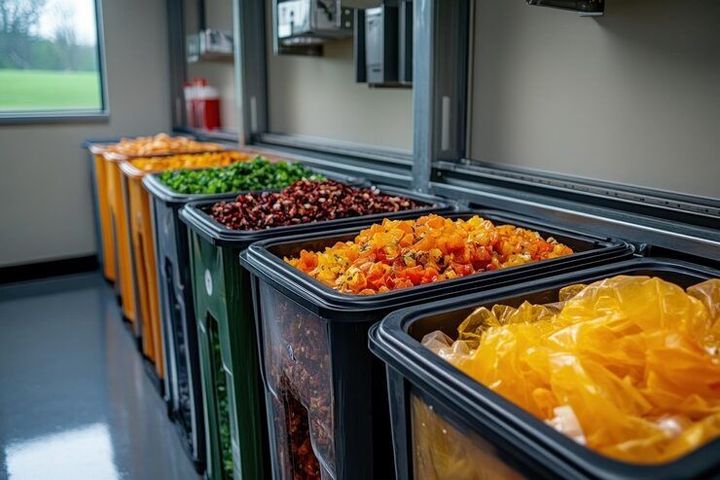
Food Waste Dehydrators Knowledge: Types, Operation, Processing Stages, Uses and Features
Food waste dehydrators are machines that process wet organic food residues by removing a large portion of their moisture through controlled heat and airflow. Food Waste Dehydrators Knowledge: Types, Operation, Processing Stages, Uses and Features explains how these systems handle kitchen scraps, prepared-food residues, vegetable trimmings, fruit peels, and similar biodegradable material. They form part of a wider approach to decentralized food-waste management, where organic material can be treated closer to where it is generated.
Importance of Food Waste Dehydrators
Wet food residues can be difficult to store and transport because moisture adds weight and supports biological activity and odors. Keeping food waste mixed with plastics, glass, metals, or other materials also makes separate treatment more difficult.
A food waste dehydrator focuses on moisture reduction. Depending on the equipment and feed material, the process can reduce mass and volume and make temporary handling easier. Results vary with moisture content, particle size, loading amount, temperature, airflow, and processing time.
Types of Food Waste Dehydrators
Batch Systems
Batch systems process a defined quantity during a cycle. Material is loaded, processed for a programmed period, and removed after the cycle.
Continuous and Semi-Continuous Systems
These designs allow material to enter more frequently while processed material moves through the equipment. They are associated with facilities that generate organic waste regularly.
Heat-and-Air and Integrated Systems
Heat-and-air systems use heated air to evaporate moisture. Some integrated machines add mixing, cutting, pressing, odor-control, and output-collection stages.
How a Food Waste Dehydrator Operates
Feeding and Inspection
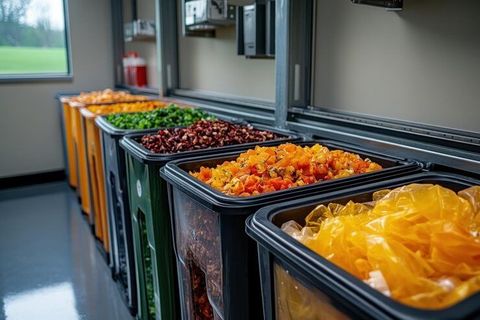
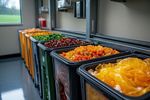
The process begins with segregated food waste. Visible contaminants and unsuitable objects are removed before loading. Large pieces may be reduced in size when required by the equipment.
Size Reduction and Mixing
Some machines cut or mix the input to create more uniform pieces. Smaller pieces can expose more surface area to heat and airflow, although the appropriate size depends on the machine design.
Heating and Moisture Removal
The chamber is heated while air moves around or through the material. Water changes into vapor and leaves with the moving air. Sensors or programmed controls may monitor temperature and processing time.
Cooling and Collection
After the heating stage, the processed material may be cooled before removal. It is then collected in a container or moved to another treatment stage.
Cleaning and Residual Handling
Chambers, filters, ducts, and contact surfaces require routine cleaning according to equipment instructions. Contaminants removed during sorting and other residual material should enter the appropriate waste stream.
Food Waste Dehydrator Processing Stages
| Processing stage | Main purpose | Key consideration |
|---|---|---|
| Segregation | Separate organic input | Remove unsuitable materials |
| Inspection | Check incoming waste | Identify contaminants |
| Size reduction | Create suitable pieces | Depends on equipment |
| Loading | Place material in chamber | Stay within rated capacity |
| Heating and airflow | Remove moisture | Control heat and airflow |
| Mixing | Improve exposure | Reduce uneven drying |
| Cooling | Lower output temperature | Supports handling |
| Collection | Gather processed material | Keep output identified |
| Further treatment | Determine next route | Follow applicable rules |
Uses and Features of Food Waste Dehydrators
Common Uses
Food waste dehydrators can be used where segregated organic waste is generated in regular quantities. Examples include restaurant kitchens, hotels, food courts, educational institutions, residential communities, and some food-processing environments.
Their role may include moisture reduction before another approved treatment route or preparation of material for controlled temporary handling. The appropriate application depends on the waste composition and local requirements.
Common Features
Equipment may include insulated chambers, temperature sensors, digital controls, mixing mechanisms, programmable cycles, odor-control arrangements, safety interlocks, overheating protection, automatic shutdown, and removable collection containers.
Recent Updates and Current Trends
From 2024 through 2026, waste management in India has placed increasing emphasis on source segregation, decentralized processing, resource recovery, and accountability for large waste generators. A major regulatory change was the Solid Waste Management Rules, 2026, which replaced the 2016 framework and took effect from April 2026. The rules require four-stream segregation at source: wet, dry, sanitary, and special-care waste.
The Central Pollution Control Board's solid-waste portal identifies kitchen waste, food waste, vegetable waste, meat, fruit waste, and flower waste within the wet-waste stream. The portal also provides information related to bulk waste generators under the 2026 framework.
The current framework also emphasizes decentralized processing at large premises. Bulk waste generators include entities meeting at least one threshold: floor area of 20,000 square metres or more, water consumption of 40,000 litres per day or more, or solid-waste generation of 100 kilograms per day or more. These entities have defined responsibilities for wet-waste processing.
A dehydrator can fit into a decentralized system as moisture-reduction equipment, but dehydration should not automatically be treated as equivalent to composting or biomethanation. The next treatment or handling route depends on the material and applicable requirements.
Laws or Policies in India
India's current framework is the Solid Waste Management Rules, 2026, issued by the Ministry of Environment, Forest and Climate Change under the Environment (Protection) Act, 1986. The rules broadly cover domestic, institutional, commercial, and other non-residential solid-waste generators.
Source segregation is required into wet, dry, sanitary, and special-care streams. Wet waste includes food and other biodegradable kitchen material, so a food waste dehydrator should generally receive properly segregated material rather than mixed municipal waste.
For bulk waste generators, the 2026 rules establish registration and responsibilities related to wet-waste processing. New bulk waste generators are required to arrange adequate wet-waste processing capacity, while existing generators unable to process wet waste on site may be subject to local-body procedures and Extended Bulk Waste Generator Responsibility requirements.
Local municipal bye-laws can add operational requirements, so equipment use, output handling, registration, and records may need to be checked with the relevant local body or State Pollution Control Board. Food businesses also remain subject to applicable food-safety rules when their activities involve food intended for human consumption.
Tools and Resources
A weighing scale can record incoming food waste, while a suitable moisture meter can compare material before and after processing. A thermometer or built-in temperature display can help track operating conditions, and an energy meter can record electricity use where measurement is available.
A simple spreadsheet can record input quantity, cycle duration, output quantity, temperature readings, electricity use, and observations:
- Date and processing cycle.
- Incoming wet-waste quantity.
- Output quantity.
- Operating duration.
- Recorded temperature, where available.
- Electricity consumption, where measured.
- Notes on contamination, odor, or equipment condition.
For Indian regulatory information, the Ministry of Environment, Forest and Climate Change publishes waste-management rules and notifications, while the Central Pollution Control Board maintains the centralized Solid Waste Management portal.
FAQs
What is a food waste dehydrator?
A food waste dehydrator uses controlled heat and airflow to remove moisture from segregated organic food residues. It can reduce the weight and volume of the processed material, but the output still requires appropriate handling.
How does a food waste dehydrator work?
It generally uses a chamber, heat source, airflow, and sometimes mixing. Food residues are loaded, exposed to controlled heat and moving air, cooled, and collected.
What are the main food waste dehydrator processing stages?
The stages commonly include segregation, inspection, size reduction when required, loading, heating, airflow, mixing, cooling, collection, and further treatment.
Can dehydrated food waste be used as compost?
Dehydration alone does not necessarily produce compost. Composting is a biological process involving controlled microbial decomposition, so additional treatment may be required.
Who may use food waste dehydrators?
They may be used in places that generate segregated organic waste, including kitchens, hotels, restaurants, institutions, residential communities, and some food-processing facilities. Equipment selection depends on waste type and quantity.
Conclusion
Food waste dehydrators use controlled heat and airflow to reduce moisture in segregated organic food residues. Their operation commonly involves inspection, size reduction, heating, mixing, cooling, and collection, with features varying by equipment design. In India, the Solid Waste Management Rules, 2026 emphasize source segregation and defined wet-waste responsibilities, particularly for bulk waste generators. A dehydrator can form one part of a broader waste-processing system, while final output handling depends on material characteristics and applicable local requirements.