Industrial Spray Drying Systems Explained: Types, Components, Applications, Benefits and Limitations
Industrial spray drying systems are used to convert liquids, solutions, emulsions, and suspensions into dry powders. The process involves dispersing a liquid feed into small droplets and exposing them to a stream of heated gas. Moisture evaporates rapidly, leaving solid particles that can be collected for further processing, storage, or packaging.
Context
Industrial spray drying systems are used to convert liquids, solutions, emulsions, and suspensions into dry powders. The process involves dispersing a liquid feed into small droplets and exposing them to a stream of heated gas. Moisture evaporates rapidly, leaving solid particles that can be collected for further processing, storage, or packaging.
Spray drying developed as industries needed practical methods for drying liquid materials while controlling the characteristics of the resulting powder. It became important in food processing, chemical manufacturing, ceramics, and other industries that handle materials in liquid form. Today, industrial spray drying systems are used to produce powders with specific moisture levels, particle sizes, and handling properties.
How Industrial Spray Drying Works
The process usually begins with preparing a liquid feed. A pump delivers the material to an atomizer, which breaks it into fine droplets inside a drying chamber. Heated air or another suitable drying gas contacts the droplets, causing moisture to evaporate as the particles form.
The resulting powder separates from the gas and is collected through equipment such as cyclones, filters, or other powder recovery systems. Exhaust gas then passes through the appropriate treatment equipment before discharge. Actual operating conditions depend on the material, equipment design, and required powder characteristics.
Main Types of Spray Drying Systems
Industrial spray dryers vary according to their atomization methods, airflow arrangements, and product requirements.
Rotary atomizer systems: A rapidly rotating disc or wheel spreads the liquid into droplets. These systems are used in various industrial applications where consistent feed distribution is important.
Pressure nozzle systems: A pump forces liquid through a small nozzle opening under pressure. The nozzle converts the feed into droplets, with their characteristics influenced by pressure, nozzle design, and material properties.
Two-fluid nozzle systems: Compressed air or another gas helps break the liquid into droplets. These systems can handle certain specialized feeds, depending on nozzle design and operating conditions.
Co-current systems: The liquid droplets and drying gas move in the same general direction. This arrangement is common when rapid initial drying and controlled product exposure to high temperatures are required.
Counter-current systems: The material and drying gas move in opposite directions. This arrangement can provide different heat-transfer characteristics but requires careful control of product temperature.
Mixed-flow systems: The airflow combines elements of co-current and counter-current movement to suit particular process requirements.
The appropriate configuration depends on feed properties, production capacity, powder quality requirements, and the sensitivity of the material to heat.
Importance
Industrial spray drying systems matter because many industries need stable, manageable powder products made from liquid ingredients. Powder form can simplify handling, transportation, blending, dosing, and incorporation into later manufacturing stages. Drying may also help extend storage stability when combined with suitable packaging and other controls.
The process affects manufacturers, equipment operators, quality-control teams, and consumers who use products made from dried ingredients. Examples include powdered milk, instant beverage ingredients, food additives, ceramic powders, pigments, and certain chemical materials. However, the suitability of spray drying depends on the composition and behavior of each feed.
Main Components of an Industrial Spray Dryer
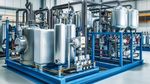
A spray drying installation contains several connected components that control feed delivery, heat transfer, powder separation, and emissions.
Feed preparation tank: Holds the liquid material and may include mixing or temperature-control equipment.
Feed pump: Moves the prepared material to the atomizer at a controlled rate.
Atomizer: Produces droplets from the liquid feed.
Drying chamber: Provides space for contact between the droplets and heated gas.
Air heater and distribution system: Supplies heated air and directs it through the chamber.
Powder recovery equipment: Collects dried particles using cyclones, filters, or related equipment.
Exhaust handling system: Manages outgoing gas and captures remaining particles where required.
Control system and sensors: Monitor variables such as temperature, pressure, airflow, and feed rate.
Additional equipment may include air filters, fluid beds, powder conveyors, cleaning systems, and explosion-protection devices. The configuration varies with the material being processed and the plant's safety requirements.
Applications Across Industries
Spray drying supports several manufacturing sectors because it can turn pumpable liquid materials into powders within a continuous process.
In the food industry, it is used for dairy powders, coffee extracts, flavor ingredients, and selected nutritional ingredients. In chemical production, it may be used for detergents, pigments, catalysts, and formulated materials. Ceramic and mineral processing can use spray drying to prepare powders with flow properties suited to pressing or shaping.
Pharmaceutical manufacturing also uses spray drying for certain ingredients and formulations under appropriate quality controls. Such applications may require specialized containment, validation, and regulatory oversight. Not every material is suitable for the process, and the final powder must meet the requirements of its intended use.
Benefits and Limitations
Spray drying has several process advantages, but its results depend on material characteristics and equipment design.
| Factor | Potential benefit | Limitation or consideration |
|---|---|---|
| Drying speed | Small droplets allow rapid moisture removal | Heat-sensitive materials may degrade |
| Powder handling | Produces particles suitable for many handling systems | Fine powders may create dust |
| Continuous operation | Supports steady industrial production | Requires coordinated equipment control |
| Product characteristics | Particle properties can be adjusted through process settings | Consistent results require careful monitoring |
| Process integration | Can connect with blending and packaging lines | Installation requires space and supporting utilities |
| Moisture reduction | Can improve storage stability for suitable products | Packaging and storage conditions remain important |
Spray drying may require substantial energy to heat the drying gas and evaporate moisture. Fine particles can also adhere to chamber walls, reduce recovery efficiency, or create cleaning challenges. In some applications, specialized equipment is needed to manage combustible dust, solvent vapors, or contamination risks.
Recent Updates
Recent developments in industrial spray drying have focused on process efficiency, automation, product consistency, and environmental performance. From 2024 through 2026, these areas have remained important across manufacturing, although adoption differs by industry and facility. There is no single design change that applies to every spray dryer.
Automation and Process Monitoring
Modern spray drying systems may use programmable controllers, temperature sensors, airflow measurements, and automated feed controls to maintain operating conditions. Some installations also use process data to identify changes in performance, detect unusual operating patterns, and support maintenance planning.
Advanced monitoring can help operators understand how feed composition, inlet temperature, outlet temperature, and atomizer settings influence the resulting powder. Automated control does not remove the need for trained operators, calibration, and product testing.
Energy Efficiency and Powder Quality
Manufacturers are examining heat recovery, improved insulation, optimized airflow, and more efficient auxiliary equipment to manage energy use. The effectiveness of these measures depends on the plant layout, material characteristics, and production requirements.
Research and development also continue to explore particle engineering, improved atomization, and combinations of spray drying with fluid-bed processing. These approaches can influence particle density, moisture content, solubility, and flow behavior. Their suitability must be assessed for the specific product and operating conditions.
Laws or Policies
Industrial spray drying systems must comply with regulations relevant to the facility, its materials, its emissions, and worker safety. Requirements vary according to the industry, location, plant capacity, and processes involved. Equipment selection alone does not establish regulatory compliance.
Industrial Regulations in India
In India, industrial facilities may need approvals under applicable state pollution-control requirements, environmental legislation, factory safety rules, building and fire-safety provisions, and local permissions. Depending on the facility and its activities, consent from the relevant State Pollution Control Board or Pollution Control Committee may be required under applicable environmental rules.
Air emissions, particulate matter, fuel combustion, and waste handling may be subject to permit conditions or prescribed standards. Facilities handling food materials must also consider relevant Food Safety and Standards Authority of India requirements. Pharmaceutical production may fall under additional rules concerning manufacturing quality and product controls.
Worker Safety and Dust Management
Spray drying can involve high temperatures, pressurized feed systems, moving machinery, and airborne fine particles. Certain organic powders and other combustible materials may present a fire or dust-explosion hazard under specific conditions. Solvent-based systems can introduce additional vapor and ignition risks.
Industrial operators may need suitable ventilation, dust collection, grounding, temperature monitoring, pressure protection, maintenance procedures, and emergency controls. Applicable requirements depend on the material and facility. Risk assessments, equipment documentation, and trained personnel form important parts of safe operation.
Tools and Resources
Technical tools and reference materials help engineers, operators, and production planners evaluate spray drying performance. Their usefulness depends on the material, the scale of operation, and the information available.
Process Calculation and Design Tools
Moisture-balance calculations can estimate how much water must be removed from a feed to reach a specified final moisture level. Energy-balance calculations help estimate the heat required for evaporation and identify opportunities to reduce energy demand. These calculations require assumptions about feed composition, inlet conditions, exhaust conditions, and heat losses.
Computational fluid dynamics software can model airflow and temperature distribution inside drying equipment. Process simulation and data-logging tools can also help evaluate operating conditions. Detailed designs generally require validated material data and appropriate engineering review.
Standards and Technical References
Useful resources include publications from the Bureau of Indian Standards, the Central Pollution Control Board, the relevant State Pollution Control Board, and the Food Safety and Standards Authority of India, where applicable. International references from organizations such as the International Organization for Standardization may also help with quality and management practices.
Equipment manuals, atomizer specifications, material safety data, and powder testing procedures provide practical information for a particular installation. Relevant measurements may include moisture content, particle-size distribution, bulk density, solubility, and powder recovery.
FAQs
What are industrial spray drying systems used for?
Industrial spray drying systems convert suitable liquid feeds into dry powders. Common applications include food ingredients, dairy powders, chemical formulations, pigments, and selected ceramic materials.
What are the main types of spray dryers?
Common types include rotary atomizer, pressure nozzle, and two-fluid nozzle systems. Spray dryers are also classified by airflow arrangement, including co-current, counter-current, and mixed-flow designs.
What are the main components of an industrial spray drying system?
Typical components include a feed tank, pump, atomizer, drying chamber, air heater, powder recovery equipment, exhaust handling system, and control instruments. Additional components depend on the process and safety requirements.
What are the benefits and limitations of spray drying?
Spray drying can provide rapid moisture removal, continuous processing, and powders with controlled characteristics. Limitations include energy demand, possible heat damage, particle loss, cleaning requirements, and dust-related hazards.
Which factors affect spray drying performance?
Feed composition, viscosity, atomizer settings, droplet size, inlet and outlet temperatures, airflow, and target moisture content all influence performance. Equipment design and product sensitivity also affect the final powder.
Conclusion
Industrial spray drying systems convert liquid materials into powders through atomization and rapid moisture evaporation. Their design includes feed preparation, atomization, heated-gas handling, powder recovery, and process monitoring. Applications span food, chemical, ceramic, and selected pharmaceutical manufacturing, with benefits and limitations that depend on the material and operating conditions. Energy use, product quality, emissions, and worker safety remain important considerations in system design and operation.

You May Also Like